
home page
what's new?
email bobtrubs@indigogroup.co.uk
to request updates
(please mention the
Vale of Belvoir Chronicle)
or to offer new information

Dissolution in the Vale

The remains of Thurgaton Priory in 2024.
As part of the Reformation instigated by Henry VIII in 1538 the monasteries and abbeys were closed down ('dissolved') and the clergy pensioned off. Nationally this had considerable impact, not least on the provision of healthcare and welfare for the destitute. However in the Vale there was comparatively little impact as the only priory, at Belvoir, was small while, according to Michael Honeybone, the college of priests at Sibthorpe had already become something of 'financial perquisite' for the clergy.
Belvoir Priory
Robert of Tosny built a small Benedictine house, dependant on St Albans, in 1076. It was to the north of his castle. It was the only Benedictine house in Leicestershire.

The castle in 1884 with the site of the priory to the immediate north.
The priory was fairly small, housing only four monks. It did, however, attract gifts and patronage. Many of those making donations were, like its founder, buried within the priory's church or chapter house. Among these benefactions were the advowsons of the churches at Redmile (gifted by William d'Albini) and of Woolsthorpe (gifted in 1308 by William de Ros, 1st Baron de Ros).
Belvoir Priory was dissolved, along with its motherhouse, in 1539.
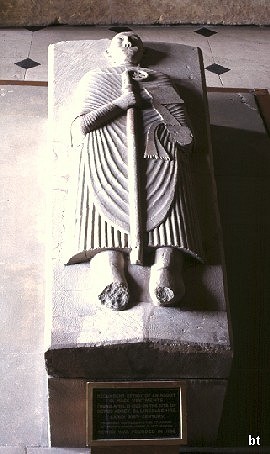
The effigy of the priory's founder was moved to Belvoir Castle chapel..

John Nichol's conjectural plan of Belvoir Priory published in 1795.
John Nichols published a plan. This suggests the wall foundations could be clearly seen in the area north of the Peacock Inn, which was said to have been built on the monks' cemetery. The plan is highly unusual, with the polygonal chapter house standing in the centre of the cloister garth (Nichols 1795, p75–81).
Some excavation seems to have been done in the later eighteenth century as Robert of Tosny's coffin was discovered. It is now in the chapel inside Belvoir Castle.
By the time Fred Hartley surveyed the site circa 1980 much less was visible, in part because the field to the east of a former tramway had been ploughed.

Belvoir Priory from R.F. Hartley, The Medieval Earthworks of North-East Leicestershire, (Leicestershire Museums 1987).
sources:
'The archaeology of the abbeys and priories of Leicestershire' by Peter Liddle with Lorna O'Brien, Transactions of the Leicestershire Archaeological and Historical Society Vol.69 (1995) p1–21.
Wikipedia page for Belvoir Priory.
Both Belvoir Priory and the college at Sibthorpe were demolished, presumably in the sixteenth century, leaving only the massive dovecote at the latter.
John Nichol's conjectural plan of Belvoir Priory.
A number of chantry chapels also closed soon after 1538, presumably because the priests associated with them had been pensioned off. And the Reformation was to result in the demise of St Ethelburga's church near Langar.
The demise of Thurgaton Priory probably caused the most ripples as, although situated on the west bank of the Trent, it owned land, churches and chapels in various places in the Vale including Cropwell Butler, Granby, Hickling, Owthorpe and Tithby.
Despite there being an Abbey Lane in Aslockton there was never an abbey there. The lane once had Holy Trinity Chapel, a peculiar under the collegiate church of Southwell Minster, but this became ruinous (perhaps as a result of the Reformation) and was incorporated into a private house, although Wikipedia states that 'some remains of [the chapel] can still be seen'.
The unplanned agricultural aftermath
The Dissolution of the monastic houses was not itself of much concern in the Vale. But the redistribution of land ownership and the preference for the new owners to enclose led to the loss of most arable farming in the Vale – and therefore the loss of many livelihoods – and the dramatic shift to pasture.This was eventually reversed as mechanised ploughing was introduced in the 1940s onwards. By the late twentieth century the Vale was back to large swathes of arable, just as it had been from Anglo-Saxon times until the mid-sixteenth century.
Back to top of this page Back to home page
This website does not gather or store any visitor information.
Copyright Bob Trubshaw 2025
No unauthorised copying
or reproduction except if all following conditions apply:
a: Copy is complete (including this copyright statement).
b: No changes are made.
c: No charge is made.
Chronicle entries
home pagethe boundaries and rivers of the Vale
long, long ago
- prehistory in the Vale
- prehistoric boundaries in the Vale
- north-south prehistoric routeways
- Romans roads in the Vale
- Roman settlements in and near the Vale
long ago
- introduction to Anglo-Saxons
- place-names of the Vale
- waterborne transport around the sixth century
- Orston's early church
- Anglo-Saxon sculpture in the Vale
- why Orston lost out to Bingham and Bottesford
- what the Normans did for the Vale
- Granby's importance in 1086
- Granby's lost castle
- the Vale's watermills in 1086
- Romanesque sculpture in the Vale
- St Remigius
- why Bottesford is in Leicestershire
- the Vale in medieval times
- medieval gargoyles of the Vale
- Eastwell's chancel screen
- St Ethelburga's church
- other early saints
- Elston's old chapel
- Muston and Long Clawson
- saltways of the Vale
- the Vale's medieval tile collection
- the Vale in Tudor times
- Dissolution in the Vale
not that long ago
- the Vale in the C17th
- the 'great and the good' of the Vale
- Bottesford's effigies
- 'wicked practice and sorcerye'
- the whales on the Whalley memorial
- Car Colston's bigoted GP cum JP
- the Vale's very own regicide
- Wiverton Hall
- five rare C17th fonts in the Vale
- pinfolds and pounds in the Vale
- dovecotes in the Vale
- the Vale in the C18th
- turnpiking the Vale
- gravestones and C18th trade routes
- goodbye 'Belvoir Angels'
- C18th gravestone carvers in the Vale
- Daffy's Elixir
- the Marquess of Granby
- Stilton from the Vale
- springs and spas of the Vale
- outstanding organs in the Vale
- Grantham canal
- changes in the Vale's agriculture since 1800
- Eastwell's recusant priest house and chapel
- Colston Bassett's ruined church
seems like yesterday
- windmills in the Vale
- stained glass in the Vale
- village life in the southern Vale 1850 to 1880
- folklore of the Vale
- Flintham museum
- lacemaking in the Vale
- gypsum pits in the Vale
- brick and tile works in the Vale
- ironstone quarrying in the Vale
- ironstone railways
- ironstone quarries of Leicestershire (YouTube video)
- The Vale's railway stations
- Orston's famous architect
- Mothers Union banners of the Vale
- redundant telephone exchanges in the Vale
- WWII airfields and pillboxes in the Vale
- the Vale in 1944
- location shooting at Belvoir Castle
- Screveton's giants
researching and writing local history
local history groups in and around the Vale
you may also be interested in
free PDFs written by Bob Trubshaw
Bob Trubshaw's YouTube channel
Rutland Village by Village website
Sepulchral Effigies of Leicestershire and Rutland