
home page
what's new?
email bobtrubs@indigogroup.co.uk
to request updates
(please mention
Fabulous Framland)
or to offer new information
Village by Village
Ab Kettleby
Asfordby
Ashby Folville
Barkestone le Vale
Belvoir
Bescaby
Bottesford
Branston
Brentingby
Brooksby
Buckminster
Burrough on the Hill
Burton Lazars
Chadwell
Cold Overton
Coston
Croxton Kerrial
Eastwell
Eaton
Edmondthorpe
Eye Kettleby
Gaddesby
Garthorpe
Goadby Marwood
Great Dalby
Grimston
Harby
Harston
Hoby
Holwell
Hose
Kirby Bellars
Knipton
Knossington
Leesthorpe
Little Dalby
Long Clawson
Saltby
Saxby
Saxelbye
Scalford
Sewstern
Shoby
Somerby
Sproxton
Stapleford
Stathern
Stonesby
Sysonby
Thorpe Arnold
Thorpe Satchville
Twyford
Waltham on the Wolds
Wartnaby
Welby
Wycomb
Wyfordby
Wymondham


Gaddesby
Gaddesby is seven miles south-west of Melton Mowbray on the road between Rearsby, Ashby Folville and Twyford . The population of the civil parish (which includes Ashby Folville and Barsby) at the 2011 census was 762. The proximity to Leicester makes it a a popular rural 'dormitory' village.The oldest record of the name is Gadesbie (Domesday Book 1086). This is either the Old Scandinavian male personal name Gaddr or the Old Scandinavian gaddr 'hill spur' plus Old Scandinavian by 'farmstead, village'. So either 'the settlement associated with Gaddr' or 'the settlement on a hill spur'. The countour lines on OS maps suggest that the latter is quite plausible.
Historically Gaddesby was part of Goscote Hundred and only became part of the Borough of Melton in 1974.
Four cropmark barrows align west-south-west to east-north-east. Other cropmarks suggest probable Iron Age enclosures.
About 2003 evidence was revealed for a Roman farmstead, burial and road. In 2022 part of a Roman cobbled trackway was discovered on the northern edge of the village.
A mound twenty metres in diameter and two metres high and surrounded by a ditch was removed in the 1960s. It was to the south-west of the village. Whether it was an exceptionally well-preserved prehistoric burial mound, or a Norman motte is not known. The ditch means it is unlikely to have been the base of a postmill, but that can't be ruled out.
The manor was given by Henry II (ruled 1154 to 1189) to the Knights Templar based at Rothley. It then passed to the Knights Hospitallers in 1312.
The exceptionally good church offers ample evidence of the growth in Gaddesby's importance as the medieval wool industry generated significant wealth in east Leicestershire. Starting in the fourteenth century there was a weekly market and annual fair. However once wool lost importance the village slowly declined into a quiet rural 'backwater'.

On the corner of Chapel Lane and Cross Street a large boulder called the 'Blue Stone'.
It is said to mark a spot from which John Wesley used to preach. Photograph taken 2002.
A Fulwelle is mentioned between 1467 and 1484. Several origins of the name are plausible. But the importance of wool at that time 'goes with' this being a 'fulling' or fuller's well.
There's a Harewell House on Highfield End.
The village had many springs, and there are still two water pumps in Chapel Lane.
Gaddesby Hall was built on the site of an earlier house called Paske Hall, which was surrounded by a moat and dated back to 1390. Paske Hall was demolished in 1744 and the present hall erected.
Over the years the hall had several owners, including the Nedham, Ayre and Cheney families.
The houses in the village formed part of the estate of Gaddesby Hall. The estate was put up for sale in 1917. After suffering neglect and damage when used by the American Armed Forces during the Second World War, in the 1950s the hall was reduced in size and renovated.

One of the distinctive local features is boundary walls made from bricks laid without mortar in a herringbone pattern.
The Methodist chapel was demolished in 1966.

The remains of a brick tower mill survive to the south-east of the village.
Pedantically, it is a few yards inside Ashby Folville parish. Photograph taken 2021.
In the church is an incised slab commemorating William Atmilend who died about 1445. 'At [the] Mill End' suggests he may have been the miller, or a more prosperous neighbour of the miller.
St Luke's church

Gaddesby church in 2000.
Gaddesby church is considered to be one of the best thirteenth/fourteenth century churches in the country. The Decorated Gothic stonework from the fourteenth century is exceptionally good. The west window of the south aisle is a tour de force of the masons' skills.
John Betjeman said it is 'perhaps the most exciting medieval church in the county' while Niklaus Pevsner thought it one of the most beautiful in Leicestershire. Sir Simon Jenkins considered both Gaddesby and Stoke Golding to be 'the palm' of the village churches in the shire.
The building started out as a simple Norman chapel, just a nave without a tower. The two aisles, the tower and the chancel were added in the thirteenth century and elaborated over the next two hundred years.
There are four twelfth/thirteenth century double-omega coffin lids. In 2011 three were outside and one inside the west end of the south aisle, although they may have been moved since.
The font is from 1320.
In the clerestory windows there are a few fragments of fourteenth century glass with leaves and flowers (although the clerestory is fifteenth century).
Details of the stained glass windows are in Paul Sharpling's Gazetteer.
The oak pews in the nave are probably fifteenth century.
F.W. Greenhill in The Incised Slabs of Leicestershire and Rutland (Leicestershire Archaeological and Historical Society 1958) describes three incised slabs, two of which are fifteenth century. One commemorates William Atmilend who died about 1445.
In an article published in 2008, Alistair Mutch looked at Gaddesby church in it social and cultural context. This is the abstract:
-
This article places the Decorated work at the church of Gaddesby in both its architectural and social context. The architectural context is pursued through a detailed consideration of the form of the buttress, which leads to connections between Gaddesby and the chapel of Merton College, Oxford. These connections are related to the social context, specifically to the career of Robert de Gaddesby. This professional administrator carried out a number of important roles, being steward for the Merton estates at Kibworth Harcourt and also at times steward for the Earl of Leicester. He also held a number of other official positions and, though the patronage of Roger Belers, was connected to the Despenser family during their period of influence over Edward II. These connections enabled de Gaddesby to accumulate considerable wealth, much of which was lavished on the church and contributed to its fine architectural heritage. Gaddesby is thus an intriguing example of the rise of secular administration and its influence on cultural developments.
If you want to delve deeper the article is online as a free PDF. The bibliographical details are: Alistair Mutch, 'Gaddesby: a Decorated church in its social and cultural context', Transactions of the Leicestershire Archaeological and Historical Society Vol. 82 (2008) p171–188.
The utterly indigestible Historic England listing runs to over a thousand words.
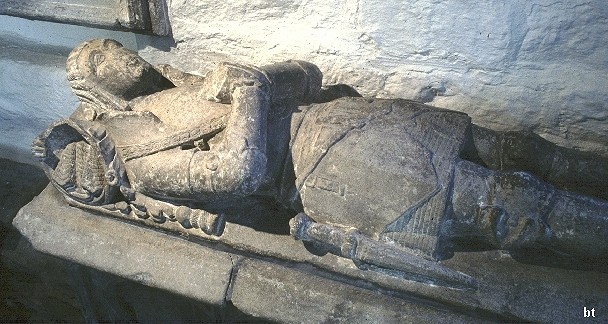
There is also an alabaster slab effigy of 1445.
The oldest of the peal of eight bells is dated 1562.
The church historian Geoffrey Brandwell admired the 'mishmash flooring', noting this was once typical of parish churches before nineteenth century restorations.

Dominating the chancel is an almost life-size memorial to Colonel Cheney, created in marble by Joseph Gott in 1848.
Colonel Edward Hawkins Cheney (1778–1848) was descended from a proud military family, one his ancestors having been Standard Bearer to Henry Tudor at the Battle of Bosworth. He enlisted with the Second Dragoons (Scots Greys) and fought at Waterloo in 1815.
The memorial shows him riding one of five horses killed under him in battle. The colonel has lost his shako, which lies with a broken strap amid the downtrodden corn into which horse and rider are floundering.
The front of the pedestal shows a scene in relief of the colonel defending the regimental colours that a French officer is trying to seize.
Colonel Cheney lived at Paske Hall and the monument was originally in the conservatory there. It was transferred to the church in 1917 prior to the demolition of the hall.
An article in Leicestershire Historian No.48 (2012) p22–7 has a detailed discussion of Cheney, his monument and its sculptor. Sadly I no longer have my copy so can't quote from it.
-
Arthur Mee knew of a few other equestrian memorials in churches. Perhaps not too surprisingly there are examples in Westminster Abbey and St Paul's Cathedral (the memorial for the Duke of Wellington).
But only three others in parish churches: a wooden one in the Lake District and two bronze ones in Cornwall and Somerset. However Mee does not suggest this is a complete list.
However Colonel Cheney's memorial does seem to be the only marble equestrian sculpture in a parish church.
As if a marble monument ain't enough, the village pub (built in 1740) also commemorates Colonel Cheney. Or at least his arms.
This website does not gather or store any visitor information.
Copyright Bob Trubshaw 2026
No unauthorised copying
or reproduction except if all following conditions apply
a: Copy is complete (including this copyright statement).
b: No changes are made.
c: No charge is made.
Framland's history
home page
long, long ago
long ago
- Anglo-Saxon Framland
- Framland's moot site
- Framland's place-name origins and Scandinavian settlement
- waterborne transport around the sixth century
- Framland's early churches
- Why Melton Mowbray needed to be called 'middle town'
- Anglo-Saxon sculpture in Framland
- what the Normans did for Framland
- Romanesque sculpture in Framland
- Framland in medieval times
- Framland's medieval carvings
- Framland's sepulchral effigies
- Framland's saltways
- Framland in Tudor times
- Dissolution in Framland
- Bottesford's C16th communion table
not that long ago
- Framland in the 17th century
- pinfolds and pounds in Framland
- Framland in the 18th century
- Framland's roads
- Framland's canals
- changes in Framland's agriculture since 1800
seems like yesterday
- watermills and windmills in Framland
- Framland in the 19th century
- ironstone quarrying in Framland
- Holwell Works
- redundant telephone exchanges in Framland
- Second World War in Framland
- MOD animals
- Framland's oil wells and coal mine
- Framland and food
free online history resources
- old OS maps
- Historic England Listed buildings database
- Sepulchral Effigies of Leicestershire and Rutland
- Open Domesday
- English Place-Name Society database
- Wikipedia list of places in Melton District (with links to village entries)
- recent bellringing in Leicestershire (updates daily)
researching and writing local history
- getting started free advice from 2005
- asking curious questions (YouTube video)
local history groups in and around Framland
- Bottesford Living History
- Eastwell Local History Group
- Goadby Marwood History Group
- Melton Mowbray and District Historical Society
- Melton Fieldwalkers
you may also be interested in
free PDFs written by Bob Trubshaw
- Earliest Churches in Leicestershire
- Earliest Churches in Nottinghamshire
- How Anglo-Saxons Found Their Way
- Anglo-Saxon Leicestershire
- Conversations in Churchyards
- Little-known Leicestershire and Rutland
Bob Trubshaw's YouTube channel