
home page
what's new?
email bobtrubs@indigogroup.co.uk
to request updates
(please mention
Fabulous Framland)
or to offer new information
Village by Village
Ab Kettleby
Asfordby
Ashby Folville
Barkestone le Vale
Belvoir
Bescaby
Bottesford
Branston
Brentingby
Brooksby
Buckminster
Burrough on the Hill
Burton Lazars
Chadwell
Cold Overton
Coston
Croxton Kerrial
Eastwell
Eaton
Edmondthorpe
Eye Kettleby
Gaddesby
Garthorpe
Goadby Marwood
Great Dalby
Grimston
Harby
Harston
Hoby
Holwell
Hose
Kirby Bellars
Knipton
Knossington
Leesthorpe
Little Dalby
Long Clawson
Saltby
Saxby
Saxelbye
Scalford
Sewstern
Shoby
Somerby
Sproxton
Stapleford
Stathern
Stonesby
Sysonby
Thorpe Arnold
Thorpe Satchville
Twyford
Waltham on the Wolds
Wartnaby
Welby
Wycomb
Wyfordby
Wymondham


Kirby Bellars

Kirby Bellars church and the River Wreake in 1986.
(Probably of no interest to anyone but myself, this is the
earliest of any of my photographs on this website.)
Kirby Bellars is west of Melton Mowbray next to the A607 to Leicester. The River Wreake runs to the north of the settlement.
The population at the time of the 2011 census was 369.
The earliest record of the name is Cherchebi (Domesday Book 1086). This is from the Old Scandinavian kirkju-by So 'the settlement with a church'.
This means the settlement – and church – were established before the arrival of Scandinavian-speaking settlers. The are no clues as to what the Old English name for the settlement might have been.
A fragment of an Anglo-Saxon ninth century cross shaft was discovered in a garden wall and donated to Leicester Museum in 1958. It is very similar to a cross shaft fragment discovered in Melton Mowbray during 2010 but has since been lost. Possibly the fragment discovered in Kirby Bellars was brought from Melton. There are photographs of both fragments in Rosemary Cramp, Jane Hawkes and Joanna Storey, Corpus of Anglo-Saxon Stone Sculpture Vol.15 East Midlands (British Academy 2026).
This manor was held by Hamo Beler in 1166. Nevertheless it was sometimes referred to as Kirkby upon the Wreak.
Kirby and Kirkby are common names for settlements nationally. Elsewhere in Leicestershire are Kirby Muxloe and Kirkby Mallory. Nottinghamshire has Kirkby in Ashfield and Kirklington.
-
In Nomina Vol.30 (2007), Carole Hough considers whether Kirkby/Kirby designate minster centers, ecclesiastical estates, or satellite settlements rather than 'merely' village churches. Based on remarks by Gillian Fellows-Jensen and others, she concludes that the name was given by Scandinavian-speaking settlers to settlements which already had an impressive stone-built church – something that would be novel and distinctive to them. Presumably places with a wooden church didn't get named Kirkby/Kirby.
Kirby indicates there was a church before the tenth century, and a high-status stone-built one. This would be consistent with an early (seventh to eighth century) mynster estate. Initial thoughts would think that such a mynster would be at somewhere more important, most obviously Melton Mowbray. But Melton may have not existed in the seventh to eighth centuries. I have gone into some detail as to why an early mynster at Kirby Bellars would be superceded when Melton was created. See Why Melton needed to be called 'Middle Town' for a detailed discussion.
Excavations in the 1960s produced evidence of Roman and Saxon occupation in the present churchyard.
A small piece of a late Anglo-Saxon frieze was discovered in the wall of a house. It is now with Leicestershire Museums.
In 2011 fieldwalking recovered a few worked flints from the Mesolithic and later, plus several sherds of Roman pottery were recovered.
The distribution of the Roman finds over a significant area suggests there may have been a Roman small town. This would be consistent with an early church, perhaps reusing one of the Roman buildings such as a bath house near the river repurposed as a baptistry.
In general the transition from late Roman settlements to early Anglo-Saxon ones is almost invisible throughout the East Midlands. After the Roman army left near the beginning of the fifth century the material culture was mostly organic so does not usually survive. Any evidence, as here at Kirby Bellars, is most likely under later buildings.
The remains of a moat is to the north of the church and extensive earthworks from a deserted settlement are to the east of the village. Details are in R.F. Hartley The Medieval Earthworks of North-East Leicestershire: A survey (Leicestershire Museums 1987) p32–4.

Although not identified as a former mill by the OS surveyors, there is documentary evidence for the railway being constructed over part of the site of a mill.

Adjacent to the Leicester to Melton road is a prominent mound with a single Scot's pine growing on it. However, this is not a burial mound. It, and a similar mound to the north-west, are probably prospect mounds associated with the ornamental early seventeenth century gardens of the manor house, now lost. Photograph taken in 2004.
A rundown watermill is depicted in an 1876 oil painting dated 1876 and titled 'The Old Mill, Kirby Bellars, Leicestershire'.
The pub is called 'The Flying Childers' after the undefeated eighteenth century racehorse. There is another pub with the same name at Stanton in Peak near Matlock and at one time a third at Bessacarr, Doncaster.
-
Flying Childers (foaled 1714 or 1715) was an undefeated 18th-century British racehorse. Widely considered the first truly great racehorse in Thoroughbred history, he was bred by Colonel Leonard Childers in Doncaster and owned by the 2nd Duke of Devonshire.
Kirby Bellars Priory
-
In 1316 Roger de Beler granted lands to support a pair of chaplains to say daily Requiem Masses in a private chantry chapel, also dedicated to Saint Peter, at Kirby Bellars Manor House for the souls of himself, his wife Alice, his parents William and Amicia, and all his ancestors. One of the chaplains was also responsible for saying Mass in a second chantry and Lady Chapel located in the north and south aisles of the Parish Church.
In 1319 the establishment was expanded to a college of secular canons comprising a warden and twelve chaplains, and Beler added the holding of Buckminster Manor as well as lands in to the north and south of Kirby parish church and other places for the upkeep of the community. The Chantry Chaplains were also responsible for offering Masses in the parish church of Saint Peter's which was subordinated to their control on 2 September 1319.
In 1359 this secular house evolved into a small priory of Canons Regular of Saint Augustine. It was the last monsatic establishment to be founded in Leicestershire before the Dissolution in the 1530s. See the source for the quote above for full details.
See also The Location of the Priory at Kirby Bellars: A Reappraisal
Sometime in the early 1500s the Priory was struck by fire which left many of its domestic buildings in ruins. In 1511 the prior and convent were authorized to give indulgences for donations to the rebuilding fund.
A visitation record from Bishop of Lincoln's Commissary from 1518 suggested many of the buildings still needed repair at that time. The same report uncovered the scandal that the sub-prior had private property, that two of the canons were suspected of immorality, and that food provided for the canons was too luxurious. Another visitation report survives from 1528 and in 1535 the priory's annual revenue was recorded as a comparatively modest £140. That assessment comes the royal visitation report issued a year before the dissolution of Kirby Bellars by which time the domestic buildings were recorded as being in good order.
The priory was dissolved in 1536 as part of the first wave of the dissolution of the monasteries.
In 1404 somewhere in the parish, presumably close to the church, was a Haliwell.
Saint Peter's church
The building is almost entirely of the thirteenth and fourteenth centuries, with some additions while the priory was in existence, such as a fifteenth century screen.There were eight phases of restoration between about 1810 and 1907.
There are effigies of Roger de Beller (died 1326) and and his wife Alice (died 1344).
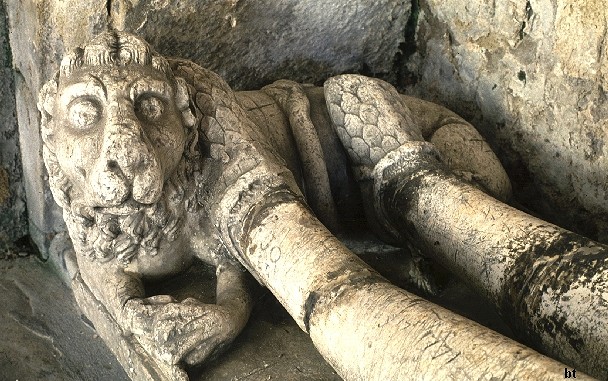
Sir Roger's feet rest on a small lion.
There are fragments of fourteenth century glass.
Details of the stained glass windows are in Paul Sharpling's Gazetteer.

Photograph taken in 2001.
Arthur Mee, writing in the 1930s, said:
-
In the churchyard is the stump of an ancient cross about which the men of the village would gather to talk over the news and rumours of the day.

A fine depiction of Charity on the memorial to Alice Meadows (died 1856) and her son, Samuel who died at the age of three months.
I wrote about this carving in Conversations in Churchyards
-
Here's Charity – depicted [in 1787] as a nursing mother. Not to be confused with the Blessed
Virgin Mary and baby Jesus – way too Catholic at the time. There's a much later
depiction of Charity at Kirby Bellars. But she hasn't got a baby at her breast. So it's
almost soft porn, at least by the standards of the day.
This website does not gather or store any visitor information.
Copyright Bob Trubshaw 2026
No unauthorised copying
or reproduction except if all following conditions apply
a: Copy is complete (including this copyright statement).
b: No changes are made.
c: No charge is made.
Framland's history
home page
long, long ago
long ago
- Anglo-Saxon Framland
- Framland's moot site
- Framland's place-name origins and Scandinavian settlement
- waterborne transport around the sixth century
- Framland's early churches
- Why Melton Mowbray needed to be called 'middle town'
- Anglo-Saxon sculpture in Framland
- what the Normans did for Framland
- Romanesque sculpture in Framland
- Framland in medieval times
- Framland's medieval carvings
- Framland's sepulchral effigies
- Framland's saltways
- Framland in Tudor times
- Dissolution in Framland
- Bottesford's C16th communion table
not that long ago
- Framland in the 17th century
- pinfolds and pounds in Framland
- Framland in the 18th century
- Framland's roads
- Framland's canals
- changes in Framland's agriculture since 1800
seems like yesterday
- watermills and windmills in Framland
- Framland in the 19th century
- ironstone quarrying in Framland
- Holwell Works
- redundant telephone exchanges in Framland
- Second World War in Framland
- MOD animals
- Framland's oil wells and coal mine
- Framland and food
free online history resources
- old OS maps
- Historic England Listed buildings database
- Sepulchral Effigies of Leicestershire and Rutland
- Open Domesday
- English Place-Name Society database
- Wikipedia list of places in Melton District (with links to village entries)
- recent bellringing in Leicestershire (updates daily)
researching and writing local history
- getting started free advice from 2005
- asking curious questions (YouTube video)
local history groups in and around Framland
- Bottesford Living History
- Eastwell Local History Group
- Goadby Marwood History Group
- Melton Mowbray and District Historical Society
- Melton Fieldwalkers
you may also be interested in
free PDFs written by Bob Trubshaw
- Earliest Churches in Leicestershire
- Earliest Churches in Nottinghamshire
- How Anglo-Saxons Found Their Way
- Anglo-Saxon Leicestershire
- Conversations in Churchyards
- Little-known Leicestershire and Rutland
Bob Trubshaw's YouTube channel