
home page
what's new?
email bobtrubs@indigogroup.co.uk
to request updates
(please mention
Rutland Village by Village)
or to offer new information
Village by Village
AshwellAyston
Barleythorpe
Barrow
Barrowden
Beaumont Chase
Belmesthorpe
Belton-in-Rutland
Bisbrooke
Braunston-in-Rutland
Brooke
Burley
Edith Weston
Egleton
Empingham
Essendine
Exton
Glaston
Great Casterton
Greetham
Gunthorpe
Langham
Leighfield
Little Casterton
Lyddington
Lyndon
Manton
Market Overton
Martinsthorpe
Morcott
Seaton
South Luffenham
Stoke Dry
Stretton
Teigh
Thistleton
Thorpe by Water
Tickencote
Tinwell
Tixover
Wardley
Whissendine
Whitwell
Wing

Ashwell
Located in the north-west of Rutland in the valley of the River Eye, Ashwell was in the Hundred of Alstoe.In Water Lane are several attractive seventeenth century houses.
Where was the ash well?

Ashwell's well in 2024.
In recent decades the well which gives the village its name is assumed to be the spring which emerges from a bank of ironstone adjacent to the sharp bend on the Oakham road just before the Langham road intersection.
The cold water of the spring has a reputation having the ability to heal rheumatic disorders and constipation. More recently the spring become known as the Wishing Well. Because of the inscription (see below) several writers, myself included, consider it to be a holy well. But it's unlikely to have been a holy well in medieval times.
However there is another, these days unnamed, well near the manor house. The water was said have healing properties. I suspect the manor house well may have been the one with the ash tree that gave the village its name.
In the eighteenth century a protective stone structure about eight feet high was erected around the Oakham road spring, the water issuing into a trough. The open front had an iron gate and the structure was capped with a cross. The structure and the gate would have been to minimise the chance of animals polluting the water. The original cross disappeared in the 1980s, and the gate was long-gone by then. A replacement cross and gate were installed in 1999 or 2000.
A slightly damaged inscription carved in a stone above the well reads:
-
All ye who hither come to drink
Rest not your thoughts below
Look at that sacred sign and think
Whence living waters flow.
This is almost the same as an inscription on a conduit head at Greetham. As the Greetham inscription seemingly dates from the 1880s I am assuming the Ashwell inscription was inserted into an existing structure sometime around 1890.
St Mary's church
Ashwell's church is mostly thirteenth and fourteenth century, although one bay of the north arcade is from about 1190. There was a major restoration in 1851 by William Butterfield which included the removal of the clerestory and the addition of two lychgates at the entrances to the churchyard.
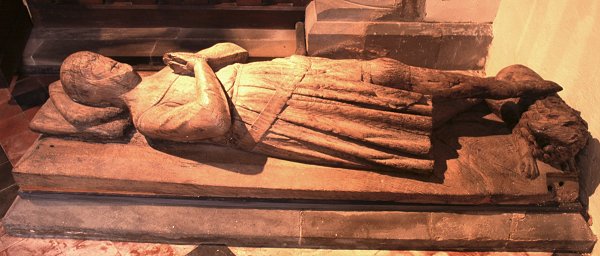
This ancient figure of a knight is depicted in a hauberk with the head resting on two cushions, the top one diamond-shaped. The face is now almost devoid of features and there is a sword hanging from the sword belt. The hands are in prayer and feet rest on a lion regardant.
Although we do not know for certain whom this effigy represents it is recorded that about 1280 a knight named Sir Thomas Tuchet is recorded to have left Ashwell to fight in the Crusades.
An incised slab commemorating John Vernam (or Vernon) and his wife, is now covered in seventeenth-century graffiti. Also in the north chapel is an alabaster effigy to a priest situated upon an earlier, graffiti-covered tomb.
The Royalist rector, Thomas Mason, was ejected in 1644 and Richard Levett (or Levet) was appointed in his place on 13 May 1646. Mason was reinstated in 1660 when Charles II was restored to the throne and then served for twenty years until his death.
Levett was the father of Sir Richard Levett who was possibly born in Ashwell. Richard became Lord Mayor of London in 1699 and owner of Kew Palace. Sir Richard's grandson, Levett Blackborne, was a barrister and longtime adviser to Charles Manners, 4th Duke of Rutland. He sold the Levett properties at Kew to the royal family.
The rector of Ashwell, James Adams, won a Victoria Cross in Afghanistan in 1879. He died in 1903 and is buried in the churchyard. He is only chaplin in the British Army to have been awarded a VC.
Victoria County History page for Ashwell.
Back to top of this page Back to home page
This website does not gather or store any visitor information.
Copyright Bob Trubshaw 2026
No unauthorised copying
or reproduction except if all following conditions apply
a: Copy is complete (including this copyright statement).
b: No changes are made.
c: No charge is made.
Rutland's history
home page
long, long ago
long ago
- Anglo-Saxon Rutland
- Rutland's place-names
- waterborne transport around the sixth century
- Rutland's early churches
- Anglo-Saxon sculpture in Rutland
- The Matter of Rutland
- what the Normans did for Rutland
- Romanesque sculpture in Rutland
- Rutland's royal forests
- Rutland in medieval times
- Rutland's scratch dials
- Rutland's medieval carvings
- Rutland's sepulchral effigies
- Rutland's saltways
- Rutland in Tudor times
- Dissolution in Rutland
not that long ago
- Rutland in the 17th century
- pinfolds and pounds in Rutland
- dovecotes in Rutland
- Rutland in the 18th century
- turnpiking Rutland
- Rutland's springs and wells
- changes in Rutland's agriculture since 1800
seems like yesterday
- Rutland's dialect
- Rutland's folk customs
- travellers in Rutland
- watermills and windmills in Rutland
- breweries in Rutland
- gasworks in Rutland
- ironstone quarrying in Rutland
- Zeppelins over Rutland
- redundant telephone exchanges in Rutland
- Second World War in Rutland
- WWII airfields and pillboxes in Rutland
- the making of Rutland Water
- Rutland Weekend Television
free online history resources
- Victoria County History: Rutland volume one
- Victoria County History: Rutland volume two
- free PDFs of Rutland Record issues 1 to 50
- old OS maps
- Historic England Listed buildings database
- Sepulchral Effigies of Leicestershire and Rutland
- Open Domesday
- English Place-Name Society database
- Wikipedia list of places in Rutland (with links to village entries)
- Wikipedia list of people from Rutland
researching and writing local history
- getting started free advice from 2005
- asking curious questions (YouTube video)
local history groups in and around Rutland
- Belton-in-Rutland History Society
- Cottesmore History and Archaeology Group
- Langham Village History Group
- Lyddington Manor History Society
- Rutland Local History and Record Society
with free PDFs of over forty issues of the Rutland Record - Uppingham Local History Study Group
you may also be interested in
free PDFs written by Bob Trubshaw
- Earliest Churches in Nottinghamshire
- How Anglo-Saxons Found Their Way
- Anglo-Saxon Leicestershire
- Conversations in Churchyards
- Little-known Leicestershire and Rutland
Bob Trubshaw's YouTube channel