
home page
what's new?
email bobtrubs@indigogroup.co.uk
to request updates
(please mention
Rutland Village by Village)
or to offer new information
Village by Village
AshwellAyston
Barleythorpe
Barrow
Barrowden
Beaumont Chase
Belmesthorpe
Belton-in-Rutland
Bisbrooke
Braunston-in-Rutland
Brooke
Burley
Edith Weston
Egleton
Empingham
Essendine
Exton
Glaston
Great Casterton
Greetham
Gunthorpe
Langham
Leighfield
Little Casterton
Lyddington
Lyndon
Manton
Market Overton
Martinsthorpe
Morcott
Seaton
South Luffenham
Stoke Dry
Stretton
Teigh
Thistleton
Thorpe by Water
Tickencote
Tinwell
Tixover
Wardley
Whissendine
Whitwell
Wing

Exton
Exton is to the north of Rutland Water. In 2016 the parish incorporated the deserted settlement of Horn.The name Exton derives from 'ox farm'. It was in Alstoe Hundred.
A document of 1185 refers to Exton Park as a wooded farm enclosed for hunting deer. Indeed, at 1,500 acres (600 hectares) Exton was once Rutland's largest park; the current park is still 1,000 acres (400 hectares).
Much of the village almost certainly once stood around the church as lots of humps and bumps can be seen to the south and south-east of the church. It was known as 'Little Exton'. Most of these dwellings were probably cleared away when Old Hall was built in the early seventeenth century as they are not shown on an engraving of the village prepared about 1739. The few remaining cottages were removed about 1860.
Now hidden by shrubs and trees, just to the east of the church are the remains of Old Hall, which burnt down in 1810. The ruins are on Historic England's Heritage at Risk Register, at priority category: C – 'slow decay; no solution agreed'.

Old Hall in 2001.
New Hall was built nearby in the Jacobean style in 1850 around an old farmhouse that had been extended in 1811. It includes a Roman Catholic chapel built in 1868–9 for the family's use.
A straight mile of chestnuts, limes, ash, birch, beech and sycamore lead to the park. In the park are large ornamental lakes and various follies, including an extravagant summerhouse called 'Fort Henry' at the side of the lake, built between 1786–8 in a 'Gothick' style. At some time it lost its central dome.

'Fort Henry' by Exton Park's lake. Note there is no public access to Fort Henry. This photograph was taken in the late 1980s by Alec Moretti during an organised visit by the Wolds Historical Organisation.

'Fort Henry' before the dome was removed.

The entrance to the park has lodge cottages and stag-surmounted gate piers. Photographed in 2001.
Elsewhere in Exton Park is a stylish octagonal eighteenth century dovecote with a semi-circular cattle shelter added sometime later and (until perhaps the early 1990s) a game larder comprising a thatched conical roof supported by Tuscan columns. Neither of these are accessible to the public except when the Park has open days.
The game larder may no longer exist. The once-famous 'Bark Temple' on the hillside behind Fort Henry rotted away in the mid-twentieth century.

Oral history published in 1976 refers to a second dovecote, still extant at that time, at Barham Court (until 1938 the vicarage).
There's a summary of Exton estate's extensive records in Rutland Record No.13 while many details about Exton and the Noel Family are discussed in Rutland Record No.19.
-
'When James VI of Scotland was crowned as England’s first Stuart monarch, no other family was more closely intertwined with the lives of the royal family than the Haringtons of Exton. The connection began when the newly ennobled Lord and Lady Harington, distantly related to the Scottish king, were appointed guardian and governess of his eldest daughter, six-year-old Princess Elizabeth. While Lord and Lady Harington cared for Princess Elizabeth, their son and elder daughter were at the centre of court life. Lucy, married at 13 to the Earl of Bedford, was the favourite Lady-in-Waiting of Queen Anne of Denmark and patron and muse of poets such as John Donne and Ben Jonson. Her brother, John, was bosom friend to Henry, Prince of Wales.
It was confidently predicted that the young Harington, being "the right eye of the Prince of Wales", would "one day govern the Kingdom". However, the early death of the prince in 1612 brought an end, in Roy Strong’s words, to "England’s lost Renaissance", paving the way for the disastrous rule of his brother, Charles I.
Within two years the great Harington dynasty of Exton came to an impecunious end with the death of John, 2nd Lord Harington. His funeral sermon, preached at Exton and printed in London, lamented the loss to "the commonwealth, and especially this little Shire" of the most acclaimed young nobleman of his time.'
More about the Haringtons of Exton in Rutland Record No.30.
The present village centre is a sycamore-shaded green surrounded by attractive stone cottages, many with thatched roofs. The oldest is probably a farmhouse in Top Street dated 1701. Tudor Cottage, to the south-east of the green, was 'collaged' together in the nineteenth century from medieval fragments.
In 1983 a seventeenth century stoneware bellarmine jar was found under the hearth of a cottage in Maltings Yard, Exton. Analysis of its contents demonstrates that it had been deposited as a witch bottle.
See Rutland Record No.35.
Near the school there is a well called Hawkswell Spring with eight pillars and a stone roof.
In 1948 the Earl of Gainsborough gave the United Steel Company a lease to quarry ironstone at Exton Park. Extensive ironstone extraction took place to the east of the village until 1974.

Three wagon cards from 1971 for ironstone heading to Scunthorpe. The top right one is for ironstone from Exton Park; the others are for ironstone loaded at Stainby, Lincolnshire, immediately to the east of Buckminster.
Thanks to Philip Thorpe for donating these to me.
In the south of the parish towards Rutland Water is Barnsdale Gardens which were created by Geoff Hamilton of the BBC television series Gardeners' World.
A detailed History of Exton has been compiled by Meryl Hart and Paul Taylor. It can be downloaded here (note it does not appear on screen until you check your downloads folder).
SS Peter and Paul's Church

The church, dedicated to SS Peter and Paul, is one of the finest in Rutland with an unusual spire on an octagonal base. It was much restored in the 1850s. Inside is a late fourteenth century font with prominent faces.
But the real splendours of this church are nine superb effigies depicting members of the two most important dynasties in Rutland, the Harington and Noel families.
These monuments are excellent examples of the evolving styles fashionable from the fourteenth to eighteenth centuries. Three are by the nationally-famous sculptors Grinling Gibbons (1648–1721) and Joseph Nollekens (1737–1823).
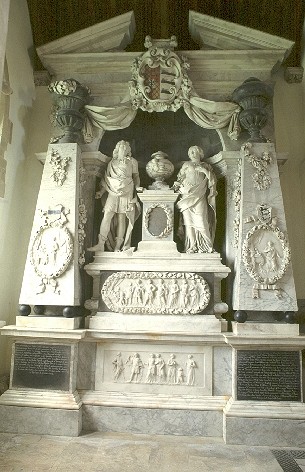
Grinling Gibbons' monument to Baptist and Elizabeth Noel.
Gibbons' twenty-two feet high memorial in black and white marble to Baptist Noel is an early example of depicting the deceased in Classical dress. This larger-than-life (in all senses) creation may hold the record for the largest number of figures on one sepulchral monument, as no less than twenty-five people are depicted, including all four of Baptist's wives.
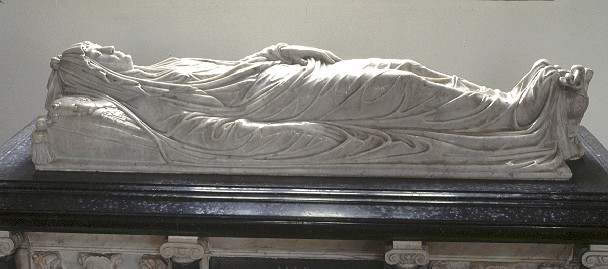
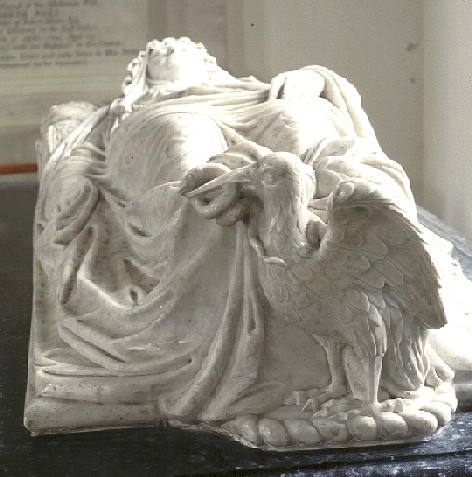
Another unforgettable effigy depicts Anne Bruce (née Chichester; died 1628) dressed in a shroud; at her feet a pelican is holding a serpent in its beak.
More about the restoration of Exton church in Rutland Record No.6.
See www.hoap.co.uk/effigies/exton.htm for full details.
The church featured in the 1980 film Little Lord Fauntleroy as the parish church of Dorincourt.
Victoria County History page for Exton.
Back to top of this page Back to home page
This website does not gather or store any visitor information.
Copyright Bob Trubshaw 2026
No unauthorised copying
or reproduction except if all following conditions apply
a: Copy is complete (including this copyright statement).
b: No changes are made.
c: No charge is made.
Rutland's history
home page
long, long ago
long ago
- Anglo-Saxon Rutland
- Rutland's place-names
- waterborne transport around the sixth century
- Rutland's early churches
- Anglo-Saxon sculpture in Rutland
- The Matter of Rutland
- what the Normans did for Rutland
- Romanesque sculpture in Rutland
- Rutland's royal forests
- Rutland in medieval times
- Rutland's scratch dials
- Rutland's medieval carvings
- Rutland's sepulchral effigies
- Rutland's saltways
- Rutland in Tudor times
- Dissolution in Rutland
not that long ago
- Rutland in the 17th century
- pinfolds and pounds in Rutland
- dovecotes in Rutland
- Rutland in the 18th century
- turnpiking Rutland
- Rutland's springs and wells
- changes in Rutland's agriculture since 1800
seems like yesterday
- Rutland's dialect
- Rutland's folk customs
- travellers in Rutland
- watermills and windmills in Rutland
- breweries in Rutland
- gasworks in Rutland
- ironstone quarrying in Rutland
- Zeppelins over Rutland
- redundant telephone exchanges in Rutland
- Second World War in Rutland
- WWII airfields and pillboxes in Rutland
- the making of Rutland Water
- Rutland Weekend Television
free online history resources
- Victoria County History: Rutland volume one
- Victoria County History: Rutland volume two
- free PDFs of Rutland Record issues 1 to 50
- old OS maps
- Historic England Listed buildings database
- Sepulchral Effigies of Leicestershire and Rutland
- Open Domesday
- English Place-Name Society database
- Wikipedia list of places in Rutland (with links to village entries)
- Wikipedia list of people from Rutland
researching and writing local history
- getting started free advice from 2005
- asking curious questions (YouTube video)
local history groups in and around Rutland
- Belton-in-Rutland History Society
- Cottesmore History and Archaeology Group
- Langham Village History Group
- Lyddington Manor History Society
- Rutland Local History and Record Society
with free PDFs of over forty issues of the Rutland Record - Uppingham Local History Study Group
you may also be interested in
free PDFs written by Bob Trubshaw
- Earliest Churches in Nottinghamshire
- How Anglo-Saxons Found Their Way
- Anglo-Saxon Leicestershire
- Conversations in Churchyards
- Little-known Leicestershire and Rutland
Bob Trubshaw's YouTube channel