
home page
what's new?
email bobtrubs@indigogroup.co.uk
to request updates
(please mention
Rutland Village by Village)
or to offer new information
Village by Village
AshwellAyston
Barleythorpe
Barrow
Barrowden
Beaumont Chase
Belmesthorpe
Belton-in-Rutland
Bisbrooke
Braunston-in-Rutland
Brooke
Burley
Edith Weston
Egleton
Empingham
Essendine
Exton
Glaston
Great Casterton
Greetham
Gunthorpe
Langham
Leighfield
Little Casterton
Lyddington
Lyndon
Manton
Market Overton
Martinsthorpe
Morcott
Seaton
South Luffenham
Stoke Dry
Stretton
Teigh
Thistleton
Thorpe by Water
Tickencote
Tinwell
Tixover
Wardley
Whissendine
Whitwell
Wing

Romanesque sculpture in Rutland
About thirty-four churches in Rutland have evidence of Romanesque construction.This page looks specifically at sculpture created between 1066 and 1180.
The following photographs and captions reveal that Rutland lives up to its motto Multum in Parvo. Clearly the Norman manorial lords were making loads of money from Rutland's peasants and churls, investing at least some of it in churches designed and decorated for the glory of God.
Tickencote

The chancel arch is the 'star of the show' at Tickencote. There are five bands of decorative heads. Originally it would have been perfectly semi-circular but has slumped over the centuries.
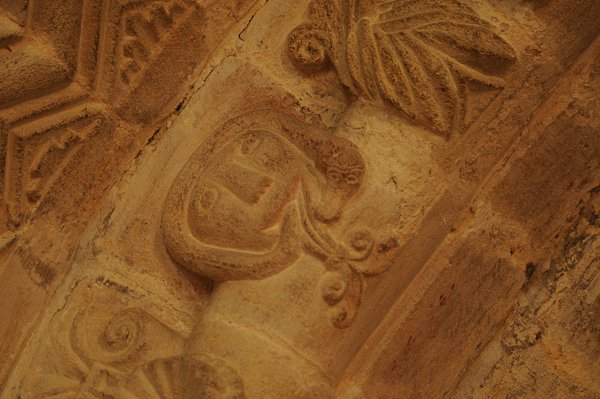

Two of the heads are sprouting foliage. The one shown in the upper photograph is seemingly wearing swan or goose neck and head as a 'scarf'. They are among the earliest such motifs in Britain, along with a foliage-sprouting animal at Stoke Dry (see below).
Later foliage-sprouting faces have two sprouts or branches. These single-sprouting images are closely based on art (probably on textiles or maybe portable metalwork) originating in India which had travelled along the Silk Roads to Constantinople and thence to Britain.
This article has more details about how Indian art influenced Romanesque sculptors.

The vaulted ceiling of the chancel is a rare survival. The masons' marks on these stones also appear on stones in Canterbury Cathedral crypt, built about fifteen to twenty years after this chancel.

The boss in the centre of the chancel roof has three heads, two human and one bear-like.


In the nave at Tickensote is a set of quite expressive twelfth century corbels supporting the roof timbers. The facial features are 'chunkier' than corbels from a century or more later.
I am not aware of any figural corbels of this date in adjoining counties. Please email bobtrubs@indigogroup.co.uk if you know of any.

The font at Tickencote is well-carved. There is just one human head, on the corner nearest the camera.
Stoke Dry

The two columns either side of the chancel arch inside Stoke Dry church are decorated with intermingled figures. Now it is quite tricky to make them out. But when they were carved they would have been painted, making it easier to recognise what is depicted.

One of the motifs on the north column is a foliage-sprouting quadruped. Like the two heads at Tickencote this is copied from Indian art and among the earliest foliage-sprouters in Britain.

The south column has the oldest-known depiction of a bell-ringer. He is ringing the bell for a funeral because on the left a human-headed demon is trying to stop Archangel Michael from assisting the deceased's soul (represented as a cockerel-like bird) to get to Heaven. According to surviving contemporary sources, in the eleventh century the ringing of the bell before a funeral was specifically to summon Archangel Michael to assist as a psychopomp.
Possibly these columns were not originally part of the chancel arch but created for an eleventh-century west doorway, since removed. Why? Because in the eleventh century funerals exited from a west door. At the time west doorways were more common than south doorways.
Essendine

The nave of Essendine church is eleventh century, with later windows. But the south doorway is original. The chancel, on the right, was added in the nineteenth century.

The doorway has columns similar in size to those supporting the chancel arch at Stoke Dry but decorated only with a geometrical design, now rather weathered.

The tympnanum above the doorway depicts Christ in Majesty with two angels. Christ's 'halo' ('mandalora') is almond-shaped. This design of Christ in Majesty is most commonly encountered in northern France, suggesting the mason was brought over from Normandy.
This is an accomplished piece of sculpture, carved from the best limestone available, presumably the quarries at Ketton. It would have been painted and perhaps partially gilded when new.
Ridlington

Ridlington also has a Romanesque tympanum, now inside the church. Originally it would have been outside, above a doorway. Again you need to imagine it quite garishly painted.
The left-hand animal is gryphon or griffin. The right-hand animal is a lion.
Egleton

Two even more mythical beasts adorn the Romanesque tympanum inside Egleton church. Again, when carved it would have been outside, above a doorway. The two heads either side are probably corbels, so originally not intended for the doorway.
Little Casterton

Little Casterton also has a tympanum now inside the church. Again with enigmatic wheels either side of a Tree of Life. Photograph by Tina Negus.
Oakham


Oakham church has twelfth century columns and capitals including a foliage-sprouting human (top) and a dragon or wyvern (above). They would have been painted when new.
Already the foliage-sprouter design has become symmetrical, with two branches. This configuration was depicted frequently until the mid-fifteenth century, and was revived in the 1980s onwards. Along the way, in the 1930s, it had been wrongly dubbed the 'green man'.
Morcott

The north arcade of Morcott church is an excellent example of Romanesque architecture.

The capitals are decorated with stylised vegetation. Whether the mason realised it or not he was carving lotus leaves and buds. So once again working from artwork originating in India but thought to have been from Constantinople.

The mason got bored with vegetation and snuck in a simple human head.

And a more demonic little chappie.
There are similar capitals at Whissendine.
Greetham

The font at Greetham was carved by a mason who wanted to show off. The base is cylindrical and the top is square so the transition between the two is tricky. And then he carves seven 'creases' into that complex curve. Eight times! It is a tour de force of Romanesque carving.
The four heads in each corner symbolise the headwaters of the four rivers of Paradise. Seriously. The rite of blessing water to be used for baptism involves reciting the biblical passage that names these four headwaters. And, until the sixteenth century, the rite was in Latin. And the Latin word used for 'headwaters' is caput. As in English 'decapitate'. So the mason has indulged in some appropriate wordplay.
I think the complex 'pleats' on the side of this font are intended to represent water flowing from a spring or fountain. If only some traces of original paint had survived!
Brooke

Brooke church has a font which is a simpler version of the one at Tickencote. But very neatly done.
The columns and capitals visible in the background are also twelfth century. But with minimal decoration. There is also a Romanesque south doorway.
Back to top of this page Back to home page
This website does not gather or store any visitor information.
Copyright Bob Trubshaw 2026
No unauthorised copying
or reproduction except if all following conditions apply:
a: Copy is complete (including this copyright statement).
b: No changes are made.
c: No charge is made.
Rutland's history
home page
long, long ago
long ago
- Anglo-Saxon Rutland
- Rutland's place-names
- waterborne transport around the sixth century
- Rutland's early churches
- Anglo-Saxon sculpture in Rutland
- The Matter of Rutland
- what the Normans did for Rutland
- Romanesque sculpture in Rutland
- Rutland's royal forests
- Rutland in medieval times
- Rutland's scratch dials
- Rutland's medieval carvings
- Rutland's sepulchral effigies
- Rutland's saltways
- Rutland in Tudor times
- Dissolution in Rutland
not that long ago
- Rutland in the 17th century
- pinfolds and pounds in Rutland
- dovecotes in Rutland
- Rutland in the 18th century
- turnpiking Rutland
- Rutland's springs and wells
- changes in Rutland's agriculture since 1800
seems like yesterday
- Rutland's dialect
- Rutland's folk customs
- travellers in Rutland
- watermills and windmills in Rutland
- breweries in Rutland
- gasworks in Rutland
- ironstone quarrying in Rutland
- Zeppelins over Rutland
- redundant telephone exchanges in Rutland
- Second World War in Rutland
- WWII airfields and pillboxes in Rutland
- the making of Rutland Water
- Rutland Weekend Television
free online history resources
- Victoria County History: Rutland volume one
- Victoria County History: Rutland volume two
- free PDFs of Rutland Record issues 1 to 50
- old OS maps
- Historic England Listed buildings database
- Sepulchral Effigies of Leicestershire and Rutland
- Open Domesday
- English Place-Name Society database
- Wikipedia list of places in Rutland (with links to village entries)
- Wikipedia list of people from Rutland
researching and writing local history
- getting started free advice from 2005
- asking curious questions (YouTube video)
local history groups in and around Rutland
- Belton-in-Rutland History Society
- Cottesmore History and Archaeology Group
- Langham Village History Group
- Lyddington Manor History Society
- Rutland Local History and Record Society
with free PDFs of over forty issues of the Rutland Record - Uppingham Local History Study Group
you may also be interested in
free PDFs written by Bob Trubshaw
- Earliest Churches in Nottinghamshire
- How Anglo-Saxons Found Their Way
- Anglo-Saxon Leicestershire
- Conversations in Churchyards
- Little-known Leicestershire and Rutland
Bob Trubshaw's YouTube channel