
home page
what's new?
email bobtrubs@indigogroup.co.uk
to request updates
(please mention
Rutland Village by Village)
or to offer new information
Village by Village
AshwellAyston
Barleythorpe
Barrow
Barrowden
Beaumont Chase
Belmesthorpe
Belton-in-Rutland
Bisbrooke
Braunston-in-Rutland
Brooke
Burley
Edith Weston
Egleton
Empingham
Essendine
Exton
Glaston
Great Casterton
Greetham
Gunthorpe
Langham
Leighfield
Little Casterton
Lyddington
Lyndon
Manton
Market Overton
Martinsthorpe
Morcott
Seaton
South Luffenham
Stoke Dry
Stretton
Teigh
Thistleton
Thorpe by Water
Tickencote
Tinwell
Tixover
Wardley
Whissendine
Whitwell
Wing

Tickencote
Tickencote is in the east of Rutland close to the A1 and slightly over three miles north of Stamford.The meaning of the place-name suggests a rather mundane origin. There was once nothing more distinctive hereabouts than 'a shed for young goats'.
Tickencote was in East Hundred, formerly Witchley.
Tickencote has literary connections as the poet John Clare (1793–1864) met his wife, Martha ('Sweet Patty of the Vale'). while drinking at the Flower Pot Inn (now a house) in Tickencote.

There is an old mill by the River Gwash to the south-west of the church; it stopped working in the 1900s. The impressive stone-built building is eighteenth century.
SS Peter and Paul's church
SS Peter and Paul's church is perhaps best described as 'Normanesque'.With the exception of the chancel arch, the church was rebuilt in 1792 by Miss Eliza Wingfield from the designs of Samuel Pepys Cockerell. The whole of the building is said to have been in a state of dilapidation and decay in the years immediately preceding the rebuilding.
Earlier in his career Cockerell had been Clerk of Works at the Tower of London, where the White Tower is a fine example of Norman architecture. However in the eighteenth century Norman architecture was not fully understood.
As a result the west wall of the church was inspired by Nicholas Hawksmoor, resulting in a unique blend of eleventh and eighteenth century ideas.

The stone vaulted roof of the chancel is unique in an English parish church and comparable only to the choir of Canterbury Cathedral, which was built later in the twelfth century. The connections are close as the same masons' marks are found at both Tickencote and Canterbury.
Note that the chancel roof was rebuilt in 1792 so how well it reproduces the old one is unknown.

At the apex of the vault is a boss carved with three faces, said to depict a monk's head and two muzzled bears. It is probably the oldest Romanesque roof boss in the country.
Above the chancel is a priest's chamber, although the stairs providing access were removed in 1792. Such priest's chambers above Romanesque chancels have rarely survived.

The chancel arch is a tour de force of Romanesque exuberance from about 1160–70, or perhaps a little later.
There are five bands of decoration, including squared-off foliage and menacing beak heads. It was probably built between 1130–50 and the craftsmen may have been the same ones responsible for the west front of the church at Tutbury, Staffordshire.
It was originally semi-circular but settlement has caused it to spread.
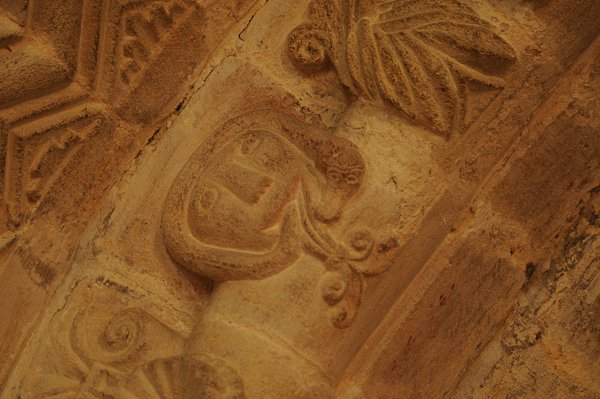

These two foliage sprouting heads are among the earliest examples of this motif in the country.
They are at an 'odd angle' because this is their position on the chancel arch.
Another early foliage-sprouting quadruped is at Stoke Dry.
All three have a row of 'beads' down the middle of the stylised foliage. This is characteristic of Indian art at the time, which includes foliage-sprouting mythical creatures. Indian decorative textiles and metalwork, along with small sculptures in ivory and metal, would have been traded along the Silk Roads to Constantinople, then brought over the Alps and along the Rhine to northern Europe and thence the British Isles. The people who bought such items would not be aware they originated a long way east of Constantinople.

The same row of 'beads' is also present on this stylised leaf.
In Indian art these 'beads' were specifically thought of a pearls.


In the nave are twelve deeply-carved twelfth century corbels; they include a foliate face, two tongue pokers, and one who is face-pulling.
The nave roof was renewed in 1875. At the same time the previously plain doorways from the nave to the vestry and to the porch were made to look Romanesque.

The rather wonderful font dates from about 1200.
The main decoration comprises architectural arcades and stylised vegetation, but there are human heads on the corners. As at Greetham these human heads may symbolise the headwaters of the rivers of Paradise referred to in the liturgy to bless the water used for baptism. Visit the Greetham page for more details.
The columns on the base were carved into a previously plain stone sometime after 1820.

The present altar stands on a slab of Purbeck marble that is probably the pre-Reformation altar.
Victoria County History page for Tickencote.
Back to top of this page Back to home page
This website does not gather or store any visitor information.
Copyright Bob Trubshaw 2026
No unauthorised copying
or reproduction except if all following conditions apply
a: Copy is complete (including this copyright statement).
b: No changes are made.
c: No charge is made.
Rutland's history
home page
long, long ago
long ago
- Anglo-Saxon Rutland
- Rutland's place-names
- waterborne transport around the sixth century
- Rutland's early churches
- Anglo-Saxon sculpture in Rutland
- The Matter of Rutland
- what the Normans did for Rutland
- Romanesque sculpture in Rutland
- Rutland in medieval times
- Rutland's scratch dials
- Rutland's medieval carvings
- Rutland's sepulchral effigies
- Rutland's saltways
- Rutland in Tudor times
- Dissolution in Rutland
not that long ago
- Rutland in the 17th century
- pinfolds and pounds in Rutland
- dovecotes in Rutland
- Rutland in the 18th century
- turnpiking Rutland
- Rutland's springs and wells
- changes in Rutland's agriculture since 1800
seems like yesterday
- Rutland's dialect
- Rutland's folk customs
- travellers in Rutland
- watermills and windmills in Rutland
- breweries in Rutland
- gasworks in Rutland
- ironstone quarrying in Rutland
- Zeppelins over Rutland
- redundant telephone exchanges in Rutland
- Second World War in Rutland
- WWII airfields and pillboxes in Rutland
- the making of Rutland Water
- Rutland Weekend Television
free online history resources
- Victoria County History: Rutland volume one
- Victoria County History: Rutland volume two
- free PDFs of Rutland Record issues 1 to 50
- old OS maps
- Historic England Listed buildings database
- Sepulchral Effigies of Leicestershire and Rutland
- Open Domesday
- English Place-Name Society database
- Wikipedia list of places in Rutland (with links to village entries)
- Wikipedia list of people from Rutland
researching and writing local history
- getting started free advice from 2005
- asking curious questions (YouTube video)
local history groups in and around Rutland
- Belton-in-Rutland History Society
- Cottesmore History and Archaeology Group
- Langham Village History Group
- Lyddington Manor History Society
- Rutland Local History and Record Society
- Uppingham Local History Study Group
you may also be interested in
free PDFs written by Bob Trubshaw
Bob Trubshaw's YouTube channel
Sepulchral Effigies of Leicestershire and Rutland