
home page
what's new?
email bobtrubs@indigogroup.co.uk
to request updates
(please mention
Rutland Village by Village)
or to offer new information
Village by Village
AshwellAyston
Barleythorpe
Barrow
Barrowden
Beaumont Chase
Belmesthorpe
Belton-in-Rutland
Bisbrooke
Braunston-in-Rutland
Brooke
Burley
Edith Weston
Egleton
Empingham
Essendine
Exton
Glaston
Great Casterton
Greetham
Gunthorpe
Langham
Leighfield
Little Casterton
Lyddington
Lyndon
Manton
Market Overton
Martinsthorpe
Morcott
Seaton
South Luffenham
Stoke Dry
Stretton
Teigh
Thistleton
Thorpe by Water
Tickencote
Tinwell
Tixover
Wardley
Whissendine
Whitwell
Wing

Edith Weston
Edith Weston is on the south-eastern shore of Rutland Water and is home to the main sailing club and has a fishing lodge.Locally the name is pronounced as 'Edi Wesson'.
Edith Weston originated as part of the royal manor at Ketton. As it is west of Ketton it became known as 'west tun'. The village is also named after Eadgyth ('Edith') of Wessex (1029–1075), the queen of Edward the Confessor and sister of Harold Godwinson. On Edith's death in 1075 William the Conqueror retained Rutland for himself and created a royal forest in half the county.
Pauline Stafford has written a lucid account of Queen Edith's life and kindly allowed me to include it as part of this web site as a free PDF.
Edith Weston was in Martinsley Hundred.

The base of a medieval cross survives in the centre of the village. Photograph taken in 1999.
The so-called Domesday Oak can be seen from the path running along the shore of Rutland Water, in the garden of 'The Limes' to the north-east of the church, although it probably does not date back to 1086.
Edith Weston Priory was a small alien house of Benedictine monks founded about 1114. The parent house was Abbey of Saint-Georges, Boscherville, France.
A history of the Benedictine house published in 1908 is available online.
The priory was one of two in England belonging to Abbey of Saint-Georges. Avebury Priory in Wiltshire was founded around the same time.
Like all alien houses, control and revenues passed to the Crown in times of war with France. During one of these periods the priory closed. The last known prior was in 1361, and by 1394 the church and manor had been sold to St Anne's Priory, Coventry, which did not reinstate any clergy. The probable site is now on the shoreline of Rutland Water at NGR SK925055. Three small fishponds thought to have originated with the priory are shown on the 1884 OS map to the north-west of the Hall, but these were destroyed when Rutland Water was created.
One of the oldest buildings in this attractive village is the Old Rectory, built in 1626. A subsequent rectory, an elegant stone building of about 1800, is now called Ladycroft.
Edith Weston Hall was a former country house built in an Elizabethan style by the architect Lewis Vulliamy for the Rev Richard Lucas in 1830, replacing the Old Hall which stood near the church. It was damaged by fire in 1920, was restored in 1924 and demolished in 1954.
Edith Weston features in Alan Sillitoe's 1984 novel Down From the Hill, with the main character stopping off in the Wheatsheaf for a shandy.
Apparently Down From The Hill describes a six day cycle across Britain by a seventeen year old. He returns in middle age to repeat the journey in a car, but it is a futile process. The past has gone.
Witchley Hundred moot site
To the east of Edith Weston here is still a Whytchley Warren Farm next to a triangular arrangement of lanes.Alstoe Hundred was formerly Witchley Hundred, so this triangle of land was almost certainly the moot site. The moot site for the Gartree Hundred was also in such a triangle of land. Indeed the 'gar' of Gartree probably refers to the triangle as it has the literal meaning of 'spear(-shaped)' as 'triangle' is not used in English until the late fourteenth century.
One of lanes forming the gar or triangle is a probable Roman road running south from Empingham and on to North Luffenham, Morcott and Barrowden then crossing the Welland at Turtle ('toot hill' or 'look-out hill') Bridge.

A panorama of the gar near Whitchley Warren Farm (the building in the distance on the right). The third road runs behind the hedge and in front of this former farm.
'Whichley' is from the 'woodland (clearing) of the Hwicca'. As there are four place-names within thirty miles which derive from Hwicce (Whissendine itself; Wichly in Whissendine; Whitchley in Edith Weston; Whiston, Northamptonshire) then it seems likely they share the origin of Hwicca/Hwicce. But it is not a personal name, it is a 'folk-name' or 'tribal name'.
The 'ley' is from Old English leah. So Witchley Hundred is named after the meeting place: 'the woodland clearing of the Hwicce folk/tribe'.
St Mary Church
The Grade I listed church still reveals much of its late twelfth century origins, including some decorative carving on capitals and elsewhere. Parts of the chancel arch also date to about 1170 although it was rebuilt in 1250.The north arcade was probably built 1190–5.
The tower and graceful octagonal spire are fourteenth century, with bold bug-eyed gargoyles on the corners of the tower.
In 1865 the chancel was rebuilt with an impressive vaulted roof.

An old stone altar slab is now in the north aisle. Was this first erected during Queen Eadgyth's lifetime? Or is it even older?
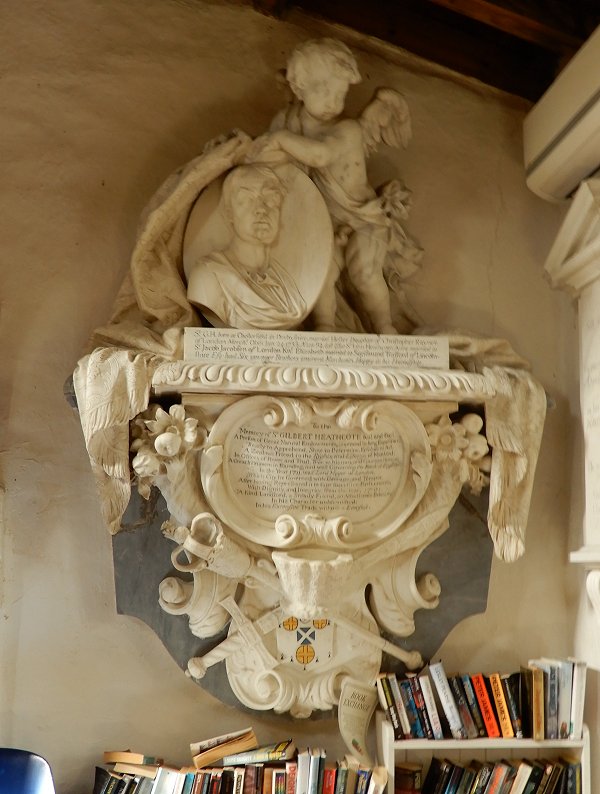
The marble memorial by John Rysbrack to Sir Gilbert Heathcote.
The memorial to Sir Gilbert Heathcote was previously at Normanton and moved when the church was deconsecrated during the construction of Rutland Water. Sir Gilbert was a founder of the Bank of England and Lord Mayor of London in 1711. At the time of his death in 1733 was reputed to be the richest commoner in England, leaving a fortune estimated to be £700,000.
The single-hand turret clock made by John Watts in the late seventeenth century (but not as early as 1658, as often stated) is now in Rutland Museum, Oakham, and has been restored to working order.
There's a detailed account of the turrent clock in Rutland Record No.13.
The organ is by Samuel Green of London and dated 1787.
The stained glass includes work by Paul Woodroffe and Hugh Arnold.
The churchyard contains some excellent seventeenth century box tombs.
Victoria County History page for Edith Weston.
Back to top of this page Back to home page
This website does not gather or store any visitor information.
Copyright Bob Trubshaw 2026
No unauthorised copying
or reproduction except if all following conditions apply
a: Copy is complete (including this copyright statement).
b: No changes are made.
c: No charge is made.
Rutland's history
home page
long, long ago
long ago
- Anglo-Saxon Rutland
- Rutland's place-names
- waterborne transport around the sixth century
- Rutland's early churches
- Anglo-Saxon sculpture in Rutland
- The Matter of Rutland
- what the Normans did for Rutland
- Romanesque sculpture in Rutland
- Rutland's royal forests
- Rutland in medieval times
- Rutland's scratch dials
- Rutland's medieval carvings
- Rutland's sepulchral effigies
- Rutland's saltways
- Rutland in Tudor times
- Dissolution in Rutland
not that long ago
- Rutland in the 17th century
- pinfolds and pounds in Rutland
- dovecotes in Rutland
- Rutland in the 18th century
- turnpiking Rutland
- Rutland's springs and wells
- changes in Rutland's agriculture since 1800
seems like yesterday
- Rutland's dialect
- Rutland's folk customs
- travellers in Rutland
- watermills and windmills in Rutland
- breweries in Rutland
- gasworks in Rutland
- ironstone quarrying in Rutland
- Zeppelins over Rutland
- redundant telephone exchanges in Rutland
- Second World War in Rutland
- WWII airfields and pillboxes in Rutland
- the making of Rutland Water
- Rutland Weekend Television
free online history resources
- Victoria County History: Rutland volume one
- Victoria County History: Rutland volume two
- free PDFs of Rutland Record issues 1 to 50
- old OS maps
- Historic England Listed buildings database
- Sepulchral Effigies of Leicestershire and Rutland
- Open Domesday
- English Place-Name Society database
- Wikipedia list of places in Rutland (with links to village entries)
- Wikipedia list of people from Rutland
researching and writing local history
- getting started free advice from 2005
- asking curious questions (YouTube video)
local history groups in and around Rutland
- Belton-in-Rutland History Society
- Cottesmore History and Archaeology Group
- Langham Village History Group
- Lyddington Manor History Society
- Rutland Local History and Record Society
with free PDFs of over forty issues of the Rutland Record - Uppingham Local History Study Group
you may also be interested in
free PDFs written by Bob Trubshaw
- Earliest Churches in Nottinghamshire
- How Anglo-Saxons Found Their Way
- Anglo-Saxon Leicestershire
- Conversations in Churchyards
- Little-known Leicestershire and Rutland
Bob Trubshaw's YouTube channel