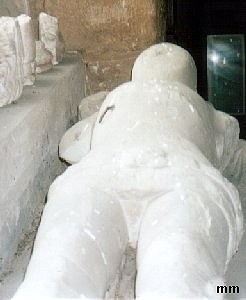
This effigy, which lies by the south wall of the South, or Carrington Chapel, is now somewhat mutilated with the arms broken off. The head is resting on a double cushion that was originally supported by angels, of which only parts of the hands remain.
This is a relatively late manifestation of the use of cushions, for the trend was coming in of placing the knight's
head on his helm. Although very worn the aventail can be just discerned, as can the cingulum militare. The feet, which are depicted wearing square-toed shoes with rowel spurs, are resting on a lion couchant regardant.
|
|
Embedded in the right side of the swelling breast is an iron spike that appears coeval with the effigy. This may have supported a shield - a mark in the effigy almost parallel with the spike on the left side of the breast may signify that there was another spike here (the prominent breast may also give support to the shield theory).
Folklore, however, tells us that the spike is the end of the lance that caused Folville's
death.
In 1590, when John Burton made his heraldic survey of the county, the coat of the Folvilles
(cross molin gules) was still discernible on the breast. There is no inscription.
|
|
The tomb-chest carries three blank shields set in quatrefoils - one on the north side and
one on each end. These shields may have been originally painted with the Folville arms; all
traces of which now having disappeared. The south side is flush against the wall so it is
impossible, without moving the chest, to know what, if anything, is on this face.
Sir Eustace, who is also represented in the tower window, was one of six brothers
who formed the nucleus of a band who terrorised the neighbourhood.
|
| |
In January 1327 he waylaid and murdered Roger Bellar,
one of the Justices Itinerant, a crime for which he was exiled. In 1333, in recognition of his raising a troop for King
Edward III's wars in Scotland, Eustace received a Royal Pardon and was allowed to return home only to be killed in a duel in 1347.
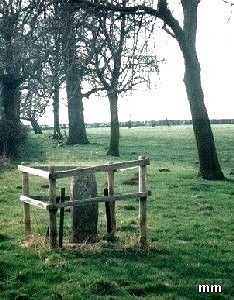
The site of Bellar's murder, at Ashby Pasture Corner, is marked by a stone, about one metre
high. Near the top of the stone there are two horizontal rows of small holes that
might have served for the fixture of a
tablet recording the event.
|
|
Sepulchral Effigies of Leicestershire and Rutland
Text copyright Max Matthews 2002. Selected text copyright Bob Trubshaw 2025–6.
Images copyright Max Matthews 2002 or Bob Trubshaw 2002, 2025–6.
No copying or reproduction without prior written permission.
Published by Heart of Albion Press
Back to top of this page
This website does not gather or store any visitor information.
|
|