|
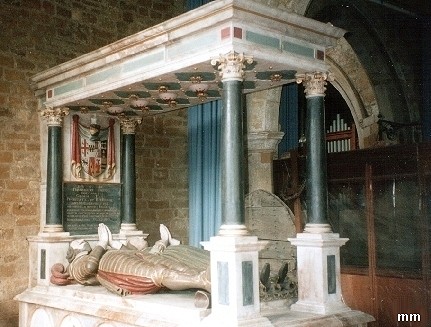
This four-poster tomb must rank as one of the finest in the county. It was originally
on the south side of the chancel but is now in the South or
Carrington Chapel. It represents Francis,
the eldest son of George, who as a youth is
depicted on his father's tomb. He lies by the side of his wife, Ann, the daughter of Thomas
Markham of Kirby Bellars.
Francis, whose head rests on a helm crested with a plume of feathers, is depicted with a
pointed beard and dressed in gilt armour, a falling collar and a sword by his side. Ann's
head rests
on a cushion with her hair combed back and wearing a large ruff.
Between the couple's feet, both with square-toed shoes, is a pyramid – a symbol of eternity.
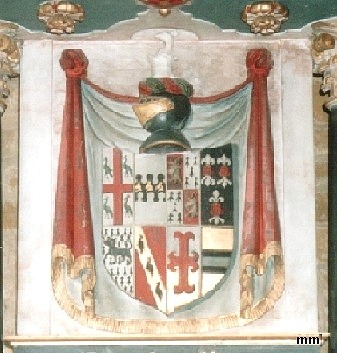
At the head of the tomb is an achievement of arms, surmounted by a helm and the Smith peacock's
head crest: Quarterly of eight
- Argent, a cross gules between four peacocks statant proper (Smith)
- Argent, on a fess nebuly sable three hare's heads (Harewell)
- Qly. 1st and 4th Gules, a goat's head erased argent, 2nd and 3rd Ermine and gules (Morton)
- Sable, three leopard's faces gules jessant-de-lis argent (Woodford).
- Ermine, a talbot passant sable (Preste)
- Gules, on a bend or three martlets proper (Brabazon)
- Per fess or and argent a cross moline gules (Foville)
- Or, a fess argent fimbriated sable (Burdett).
Under the arms is the inscription:
D.O.M.
Franciscus Smithaeus,
Eques Auratus,
Georgi F.
Probitate et Religione
Antiquis heroibus par.
Qui liberis ac nepotibus Faelix,
integritate vitae morum innocentia. Multo Faelicior
amore in suos, aequitate in omnes, pietate in Deum.
Demum avitae fidei constanti inter adversa,
Professione, Longe Faelicissimus.
Migravit e vita, pridie non maii,
aetatis suae anno LIX Christi mdcxxix.
(To God the best and greatest. Francis Smith, knight, son of George, equal to ancient heroes
in righteousness and religion who was fortunate in his children and grandchildren, in the
rectitude of his life and blamelessness of his customs. Much more fortunate in his love
towards his own, his fairness towards all and his piety towards God. At last with constant
profession of his ancestral faith in adversity, by far the most fortunate he departed this
life the day before the Nones of May, [6 May] in the 59th year of his age in the year of Christ 1629.)
The inscription on the south side of the head of the tomb tells us that in 1850 Raymond Smith,
a sculptor of 37 Gloucester Place, New Road, London, restored it. Harrison Hill further
restored it in 1989 at the cost of £3,737.
The tomb-chest has plain arcading in five panels on each side and two at the east end.
The weepers, now separated, from the monument and resting on the nearby windowsill, are
representations of the couple's children: Charles (who was murdered in France in 1664),
Thomas, Francis, John (who was knighted at Edgehill by Charles I in recognition of him having
rescued single-handed the Royal Standard), Mary, Lucy, Alathea, Ann, Elizabeth, Frances,
Dorothy, Ursula and Martha.
Sepulchral Effigies of Leicestershire and Rutland
Text copyright Max Matthews 2002. Selected text copyright Bob Trubshaw 2025–6.
Images copyright Max Matthews 2002 or Bob Trubshaw 2002, 2025–6.
No copying or reproduction without prior written permission.
Published by Heart of Albion Press
Back to top of this page
This website does not gather or store any visitor information.
|