|
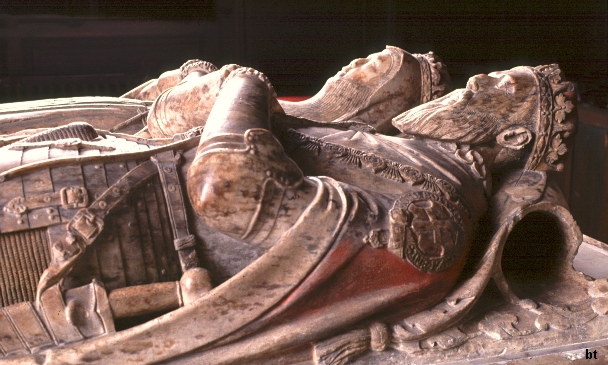
The effigies of Sir Francis Hastings, second Earl of Huntingdon, and his wife Catherine
lie in the Hastings Chapel, at the east end of the church.
Sir Francis is depicted in full armour with the robe of the Order of the Garter, still
showing some of its original red paint, descending from the left shoulder – the Garter being on the knee
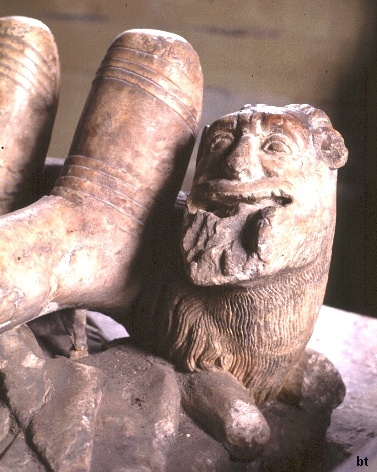
of the same side. Wearing a coronet, the head rests on a helm surmounted by a bull's head crest. A lion lies at his feet.
Catherine is depicted in a loose robe fastened at the breast by cordons.
The robe comes to small folds by her girdle and flows down to the feet, which are supported
by a, now, headless
griffin. She is wearing a coronet from which hangs light drapery as far as the elbows.
A wimple, an item of apparel that denotes widowhood, covers the lower part of the face.
Both figures have lost their hands.
The two recumbent effigies, which seem to be portraits of the deceased rather than just
representations, lie on a tomb-chest in the middle of the chapel. The monument, which is
believed
to have been built by Richard Parker, is still very gothic in feeling, and were it not
for the use
of the classical angle pilasters and Greek vases that decorate the tomb-chest it might well
pass for a much earlier creation.
The chest is profusely decorated with light-relief
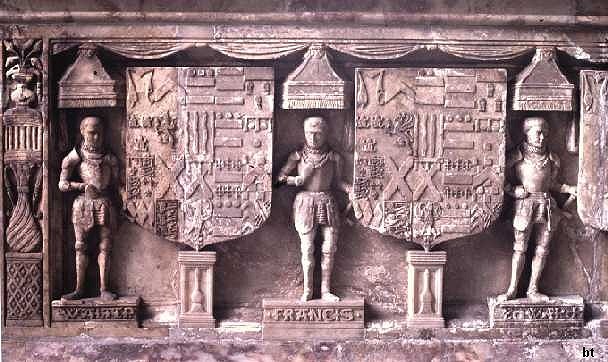
carvings of coats of arms and the family crest. Also on the chest, separated by shields and
placed in niches under fringed canopies, are small statues of the couple's sons and daughters
standing on pedestals, on which their respective names are carved.
The eldest son, Henry, who is featured on the west end of the tomb-chest, has a shield of
arms on either side of him. On his right: Qly.
- Argent, a maunch gules (Hastings)
- Gules, a fess or between three shovelers argent (Herle)
- Sable, two bars argent, in chief three plates (Hungerford)
- Per pale indented gules and vert, a chevron or
(Heytesbury)
- Azure, three garbs argent, a chief or (Peverell)
- Argent, three toads erect sable (Botreaux)
- Argent, two bars gules, in chief three torteaux (Moels)
- Ermine, a lion rampant gules crowned or, a bordure
engrailed sable bezanty (Cornwall)
- Gules, on a chevron argent three roses of the field
(Cobham)
- Or, three torteaux, a label of three points azure
(Courtenay)
- Barry of six ermine and gules (Hussey)
- Argent, a griffin segreant gules (Botreaux of Cornwall)
- Pales wavy of six or and gules (Mauduit)
- Sable, on a chief Argent three lozenges or (Molines)
- Argent, a bend sable, in chief a label gules (St Loe)
- Or, a lion rampant azure crowned gules (Clyveden)
- Masculy argent and gules (Poges)
- Paly of six or and gules (Moleyns)
- Qly. France and England, a label of three points argent, on
each point a canton gules (Clarence)
- Per pale or and sable a saltire engrailed counter-changed (Pole)
- Gules, a saltire argent, a label of three points company
azure and argent (Nevill)
- Gules, a fess between six cross crosslets or (Beauchamp)
- Checky or and azure, a chevron ermine (Guy, Earl of Warwick)
- Argent, three fusils conjoined in fess gules (Montacute)
- England with a bordure argent (Earl of Kent)
- Or, an eagle displayed vert armed gules (Monthermer)
- Or, two bars gules, in chief three torteaux (Wake)
- Or, three chevronels gules (Clare)
- Qly. Argent and gules, in the second and third quarters a fret or, over all on a bend sable three escallops argent (Spencer).
On Henry's left are the arms of his wife Katherine, daughter of the Duke of Northumberland: Qly.
- Or, a lion rampant tail forked vert (Dudley)
- Gules, a cinquefoil pierced ermine (Fitz Parnell)
- Argent, two bars gules, in chief three torteaux (Moels)
- Argent, a maunch gules (Hastings)
- Gules, seven mascles conjoined or (Quincey)
- Argent, a cross gules (?)
- Or, two lions passant in pale azure (Pagnell) (?)
- Barry of ten argent and azure, an orle of martlets gules (Valence)
- Ermine, a lion rampant gules crowned or, a bordure engrailed sable bezanty (Cornwall)
- Checky or and azure, a chevron ermine (Guy, Earl of Warwick)
- Gules, a fess between six cross crosslets or (Beauchamp)
- Gules, a chevron between ten crosses patty argent (Berkeley)
- Or, a fess between two chevrons sable (Lisle)
- Or, a lion rampant azure crowned gules (Clyveden)
- Or, a saltire engrailed between four birds (?)
- Argent, a bend engrailed sable on a chief gules a Harrington's knot or (Harrington)
- Argent, a fess dancetty sable (West)
- Qly. 1st and 4th Gules, a lion rampant, 2nd and 3rd Gules, three jessant-de-lis or
(Cantelupe)
- Azure, three bars or, on a chief of the first two pallets between two
gyrons of the second, over all an inescutcheon argent (Mortimer)
- Argent, three bendlets enhanced gules (Byron).
On the north side of the chest are the five younger sons (George, William, Edward,
Francis and Walter) who are each supporting separate shields standing on short pilasters,
bearing the following arms:
- Argent, a maunch gules (Hastings)
- Sable, two bars argent, in chief three plates (Hungerford)
- Per pale indented gules and vert, a chevron or (Heytesbury)
- Barry of six ermine and gules (Hussey)
- Azure, three garbs argent, a chief or (Peverell)
- Argent, three toads erect sable (Botreaux)
- Argent, a griffin segreant gules (Botreaux of Cornwall)
- Pales wavy of six or and gules (Mauduit)
- Argent, two bars gules, in chief three torteaux (Moels)
- Or, three torteaux, a label of three points azure (Courtenay)
- Qly. France and England, a label of three points argent, on
each point a canton gules (Clarence)
- Per pale or and sable a saltire engrailed counter-changed (Pole)
- Gules, a saltire argent, a label of three points company
azure and argent (Nevill)
- Gules, a fess between six cross crosslets or (Beauchamp)
- Checky or and azure, a chevron ermine (Guy, Earl of Warwick)
- Argent, three fusils conjoined in fess gules (Montacute)
- England with a bordure argent (Earl of Kent)
- Or, an eagle displayed vert armed gules (Monthermer)
- Or, two bars gules, in chief three torteaux (Wake)
- Or, three chevronels gules (Clare)
- Qly. Argent and gules, in the second and third quarters a fret
or, over all on a bend sable (Spencer).
To the above coats the following impalment is added to that of George:
- Azure, a fess engrailed or between three birds argent, in each beak
a cross crosslet fitch or (Port)
- Agent, three roundles gules each charged with a fleur-de-lis of the field, on a chief
azure a hunting horn stringed between ten phoen's heads, points downward, of the field (Barrow)
- Per bend sinister, ermine and erminois, a lion rampant or (Lloyd)
- Or, an eagle displayed azure beaked and legged gules, eight horseshoes or (Montgomery)
- Ermine, on a bordure gules eight horse shoes or (Marchington)
- Per pale or and sable a saltire engrailed counter-changed (Pole)
On the south side, also holding arms, are the five daughters:
Katherine Qly.
1st and 4th Argent, six cross crosslets fitchy sable, on a chief azure two mullets or
(Clinton)
2nd and 3rd Qly. Or and gules (Say)
Over all a label of three points vert
The whole impaling 21 coats of Hastings
Frances (whose effigy in 1903 suffered the indiginity of having its
face knocked off by the handle of a zinc bath)
- Sable, a lion passant guardant or between three helmets argent (Compton)
- Argent, a chevron vert within a border azure bezant (Alanby)
- Argent, a fess engrailed between six billets gules (Aylworth)
- Argent, on a chevron azure three fleurs-de-lis or (Burghopp)
- Argent, two bars in chief a mullet sable (Brereton)
- Gules, three pheon heads argent (?)
- . . . a cross flory (?)
- Or, a lion rampant gules within an orle of phoen heads gules (Proppe)
- Or, two ravens sable (Corbet)
- Ermine, three chevrons voided of the field gules, on a canton of the last a lion
passant guardant or (Orreby)
- Gules, two lions passant argent, a label of three points or (Orby)
- Berkeley impaling (Hastings 21 coats);
Anne (Hastings 21 coats)
Elizabeth Qly.
1st and 4th A fess charged with Qly. France and England within a bordure argent
and azure (Somerset)
2nd and 3rd Per pale azure and gules three lions rampant argent (Herbert).
Impaling Hastings 21 coats.
Mary (Hastings 21 coats)
Round the edge of the tomb is carved the following inscription, in which the date of Lady
Catherine's death was added after the erection of the monument – a sign that it was
constructed some time between 1561 and 1566, the year of Catherine's death:
Here lyeth ye corpse of Francys late Erle of Hutyngdun, Lord Hastynges, Hungerford,
Botreaux, Molyns and Moyles, Knight of ye honourable Order of ye Garter, whiche deceased ye
xxth daye of June an. Dni. 156and of the ladyie Katherin Countisse of Hutyngdun
his wife, whiche deceased ye XXIII daye of Sepbr anno. Dni. 1566.
In 1800 the tomb-chest was still standing in its
original position with its east end
directly against the chapel east wall.
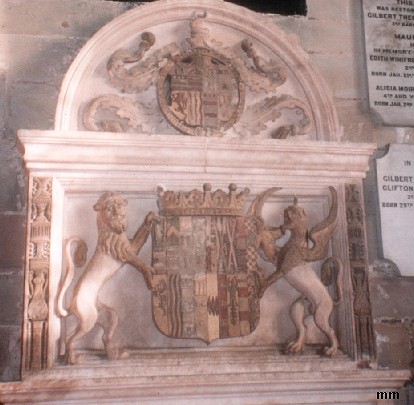
Beneath an urn are two achievements of arms:
- Argent, a maunch gules (Hastings)
- Sable, two bars argent, in chief three plates (Hungerford)
- Per pale indented gules and vert, a chevron or (Heytesbury)
- Barry of six ermine and gules (Hussey)
- Azure, three garbs argent, a chief or (Peverell)
- Argent, three toads erect sable (Botreaux)
- Argent, a griffin segreant gules (Botreaux of Cornwall)
- Pales wavy of six or and gules (Mauduit)
- Argent, two bars gules, in chief three torteaux (Moels)
- Or, three torteaux, a label of three points azure (Courtenay)
- Qly: Argent, a maunch gules (Hastings); Sable, two bars
argent, in chief three plates (Hungerford); Per pale indented gules and vert, a chevron
or (Heytesbury); Barry of six ermine and gules (Hussey)
- Azure, three garbs argent, a chief or (Peverell)
- Argent, three toads erect sable (Botreaux)
- Argent, a griffin segreant gules (Botreaux of Cornwall)
- Pales wavy of six or and gules (Mauduit)
- Argent, two bars gules, in chief three torteaux (Moels)
- Or, three torteaux, a label of three points azure (Courtenay)
impaling:
- Qly: France and England,a label of three points argent, on each
point a canton gules (Clarence)
- Per pale or and sable a saltire engrailed counter-changed (Pole)
- Gules a saltire argent,a label componé argent and azure
(Neil Earl of Salisbury and Warwick)
- Gules, a fess between six cross crosslets or (Beauchamp)
- Checky or and azure, a chevron ermine (Guy, Earl of Warwick)
- Argent, three fusils conjoined in fess gules (Montacute)
- England within a bordure argent (Earl of Kent)
- Or, an eagle displayed vert armed gules (Monthermer)
- Or, two bars gules, in chief three torteaux (Wake)
- Qly 1 and 4: Or, three chevronels gules (Clare);
Qly 2 and Argent and gules, in the
second and third quarters a fret or, over all on a bend sable (Spencer).
The Latin inscription on the urn tells us that the tomb, which was badly damaged
during the Civil Wars, was restored in 1698 by Theophilus, seventh Earl of Huntingdon (1650–1701).
In October 1530 Francis, whose father, George, had been created Earl of Huntingdon the
previous year, was appointed joint steward of the Church of the Annunciation of Mary in the
Newark, Leicester. Destroyed at the Reformation, this church stood on the site of the present
Hawthorn Building of De Montfort University. The other steward was Richard Sacheverall,
second husband of Francis's grandmother, Mary, Lady Hungerford.
In 1549, four years after he had succeeded his father as earl, Francis was appointed
chief captain of the army and fleet abroad in which capacity in helped drive the French from
Boulogne. In November of that year he wrote to the Mayor of Leicester,
Nicholas Reynold, requesting
"as many able men wherof as many of them be good archers and gunners weel furnysshyd
with armour, wepons, money and horses to serve them."
It is not known if Leicester supplied any men, but the Borough Records tell us that
the town's twenty-four aldermen did send five shillings each.
In December 1551, Francis sat at the trial of Edward, Duke of Somerset, who had been
arrested on the doubtful charge of conspiracy against the young King Edward VI (at whose
coronation in 1547 Francis had played a prominent part). In 1552 the king gave Francis
the estates that had been forfeited by John Beaumont who had been found guilty of appropriating
over £20,000 of royal funds, as well as selling titles without being in possession of the land.
On the death of Edward, in 1553, Francis declared for Lady Jane Grey, an act for which, on
Mary's accession, he was sent to the Tower. The following January he was released and sent to
arrest Jane's father, Henry, Duke of Suffolk, who had renewed his family claim to the throne.
Catherine, Francis's wife, was the eldest daughter of Henry Pole, brother of Cardinal Pole.
In 1553 the couple's eldest son, Henry, married Katherine, the eldest daughter of the Duke of
Northumberland. The fifth son, Francis, was buried at North Cadbury, Somerset, where
there is a monument to his memory.
Their youngest daughter, Mary, was nicknamed the 'Empress of Moscovia', because of her
rejection of the hand of Ivan IV, Tsar of Russia, a man who has gone into
the history books as 'Ivan the Terrible' and who at this time was still married to his seventh
wife Maria Nagaya. |