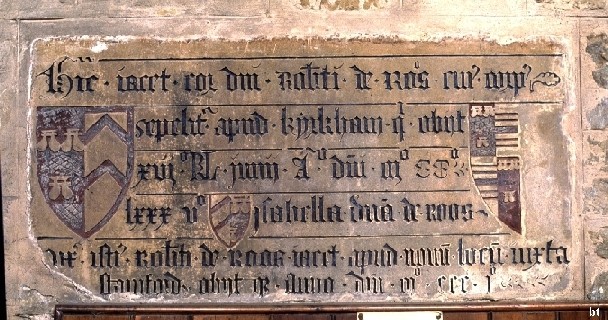
In the early medieval period it was not uncommon for a diminutive effigy to be placed in the
church where the heart was buried when the body was interred elsewhere. Indeed, near this effigy
is a slab recording the burial, at Croxton Abbey, of the heart of Robert de Roos (his body was
buried at Kirkham, Yorkshire). Bearing the arms Argent, two chevrons azure (Albini) dimidiated
with Gules, three water-bourgets argent (Roos) the abbreviated Latin inscription, which gives
the date according to the Roman calendar, reads:
Hic iacet cor dni Robti de Ros cui corp
sepelit ipud Kyrkham qi obiitt
XVI Kl junii Ao domini MCC
lxxxv. Isabella dna de Roos
ux isti Robti de Roos iacit apud novu locu iuxta
Stamford obiit q Anno dni MCCCI.
The expanded Latin reads:
Hic iacet cor domini Roberti de Roos cuius corpus sepelitut ipud Kyrkham qui obiitt XVI
Kallendas junii Anno domini MCClxxxv. Isabella domina de Roos uxor stius Roberti de Roos iacit
apud novum locum iuxta stamfordam obiit que Anno domini MCCCI.
Which translated into English gives:
Here lies the heart of Lord Robert de Roos, whose body is buried at Kirkham, who died on
the 16th Kalendar of June (17 May) AD1285. Isabella, Lady de Roos, wife of the said Robert,
who died in AD 1301, lies at Newstead near Stamford.
If the illustration on John d'Aubernoun's brass and the effigy in question
were faithful representations of the armour of the period then it is probable that the
effigy and inscription slab are connected. This, however, begs the question how did the two
relate when
they were originally erected?
Greenhill (The Incised Slabs of Leicestershire and Rutland) contends, by the evidence
of the arms and the lettering, that this slab was produced
sometime between 1353 and 1358, possibly to replace an
earlier one set up in 1285.
The second possibility is that it represents William Albini. Although Albini died much earlier than de Roos, it is known for effigies to be erected many years after the death of
the subject. If this were the case, it is possible that the artist made the effigy in the dress
of his time rather than contemporary with that of the deceased.
There are two factors that support the Albini attribution.
1: The demand for Purbeck Marble effigies began to fall off in the middle of
the 13th century, giving way to cheaper, more easily worked freestone.
2: There mention in one of the Harleian manuscripts,
cited by Nichols relating to Bottesford:
"An oulde monument in a mantle and male removed from… and here buried with this new
writing:
Hic jacet cor dni Willielmi Albiniaci, cujus corpus sepelitur apud
Novium Locum juxta Stanfordiam." (Here lies the heart of Lord William Albini whose body is buried at Newstead near Stanford.)
In the reign of Henry III William Albini III founded a Priory of Austin canons near Stanford,
where the second, third and fourth of the Albinis were buried. When William died in 1236 his
body was buried at Newstead and his heart opposite the high altar at Belvoir Priory.
Sepulchral Effigies of Leicestershire and Rutland
Text copyright Max Matthews 2002. Selected text copyright Bob Trubshaw 2025–6.
Images copyright Max Matthews 2002 or Bob Trubshaw 2002, 2025–6.
No copying or reproduction without prior written permission.
Published by Heart of Albion Press
|