|
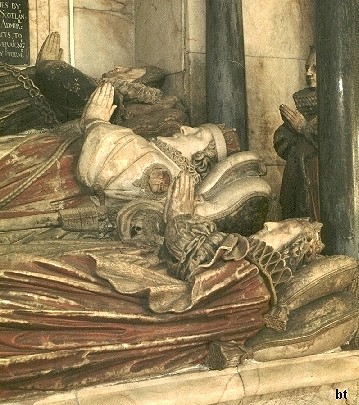
Francis, between his two wives, is depicted in the court dress of an earl, wearing the robe
and Order of the Garter. His head crowned with a coronet, rests on two embroidered cushions with
tassels. Dressed in trunk hose, short doublet and stockings, court shoes with rosettes and a
sword at his side, his feet are supported by a peacock in pride.
Frances, the first wife who died in 1608, lies on the upper level in a black robe of ermine,
low cut bodice and a farthingale with plain sleeves, vandyked at the wrists. Round her neck
is a necklace of beads. Her low stomacher is richly ornamented with lace; while at her feet
stands a wyvern.
Cecilia, on the lower level, who married Francis soon after his first wife's death,
is dressed in a robe
of ermine, coronet of guilded copper, ruff, jacket and coat. A lion is at
her feet. She died in 1653.
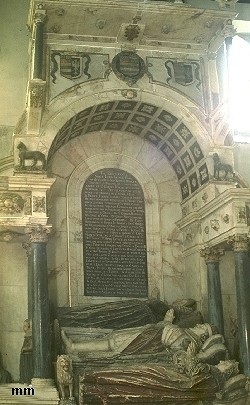
The five sets of arms are:
- Or, two bars azure, a chief quarterly of the last and gules, in the first and fourth quarters
two fleurs-de-lis, and in the second and third a lion passant guardant all or (Manners)
impaling Sable, an eagle displayed ermine within a bordure argent (Tufton)
- Or, two bars azure, a chief quarterly of the last and gules, in the first and fourth quarters
two fleurs-de-lis, and in the second and third a lion passant guardant all or (Manners)
with quarterings, crest and supporters two unicorns standing
- as 1.
- Or, two bars azure, a chief quarterly of the last and gules, in the first and fourth quarters
two fleurs-de-lis, and in the second and third a lion passant guardant all or (Manners)
impaling Argent, a bend sable within a bordure of the second engrailed
- as 4.
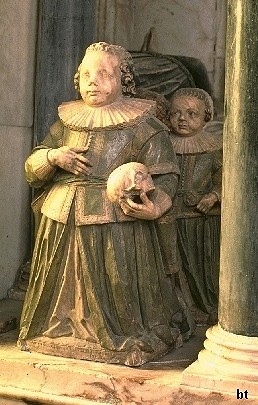
Also depicted on the tomb are the earl's three children, two of whom are holding skulls -
signifying that they predeceased their father. The inscription is of special interest as it
is the only one known in England to record the cause of death as witchcraft.
The right hon'ble and
noble Lord Francis Earle
of Rutland, Lord Roos of Hamlack,
Tresbut, and Belvoir, of the most noble
Order of the Garter, knight, lyeth here
interred. At eighteen years of age he
went to Travaile in the year 1598,
in France, Lorayne, and divers states of Italy.
He was honorably received by the princes them
selves, and nobly entertained in their courts.
In his return through Germany he had like
honour done him by Ferdinand Archduke of Austria
at his court in Gratz; by the Emperor
Mathias, and his Court in Vienna: by Count Schwarzenbough,
Lieutenant of Lavarin in Hungary: by Count
Rossembourg at Prague in Boheme: by the Marquis
of Brandenbourgh, the Dukes of Saxony, and other Ger
main Princes in the Court at Berlin. In 1604 he
was made Knight of the Bath and married the Lady
Frances Bevill, one of the daughters and coheirs of the
hon'ble knight Sir Henry Knyvett, by whom he had
issue only one daughter, the most vertuous and thrice
noble Princesse Katherine, now Duchess of Bucking.
In 1608 he married the Ldy Cecillia Hungerford, daughter
to the hon'ble knight Sir John Tufton, by whom he had
two sonnes, both which dyed in their infancy by
wicked practice and sorcerye. In 1612 he was made Lord
Lieutenant of Lincolnshire, and after justice in Eyre
of all the King's Forrests and Chases in the North of
Trent. In 1616 he was made knight of the most
noble Order of the Garter. In the year 1616 he
was one of the Lords who attended King James by
His Ma't's speciall appointm't, in his journy into Scotland.
In 1623 he was by the same King James made Admirall
of a navye of His Ma't's great shippes and pynaces, to
return Prince Charles, now our dread soveraigne,
Lord king of England, out of Spayne, which he happily performed.
|
|
|
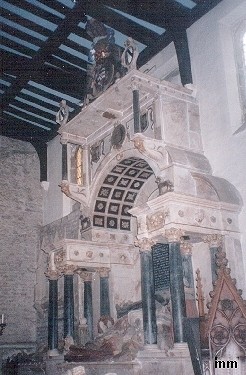
The earl erected this monument for himself in his lifetime, which is why his date of death
(17 December 1632) is not recorded. The monument was so huge that its height caused the roof of
the chancel to be raised, even so, part of the rafter had to be cut away as well as one of the
windows having to be made redundant!
Francis was close to James I who visited him at Belvoir seven times during his reign. He was in
charge of the fleet which, in April 1623, brought back Prince Charles from Spain and
subsequently attended his coronation. Francis married twice: first to Frances Knevet by whom he
had one daughter, Catherine; and secondly to Cicely Tufton by whom he had two sons who died in
infancy. On his death, at an inn at Bishops Stortford, he left clothing valued at over £500.
|
|
|
The story of the 'wicked practice and sorcerye' is as follows.
Joan Flower and her two daughters, Margaret and Phillipa, were servants in the earl's
household at Belvoir Castle. One day Margaret was
caught stealing and was dismissed by Countess Frances. This enraged Joan who lost no time in
announcing her intention of seeking revenge.
According to their confession, the Flowers entered into communication with familiar spirits
who assisted them in their wicked designs. Joan claimed that hers was in the bodily form of a
cat,
which she called Rutterkin, on whose back belongings of members of the Earl's family were rubbed
in an
attempt to effect bodily harm on their owner. In this way the Flowers were believed to have
caused the death of the Earl's wife and two sons.
It was a long time before the earl suspected the three women, but in 1618 they were arrested
and taken to Lincoln for trial.
The mother loudly protested her innocence and called for a piece of bread, wishing it might
choke her if she were guilty. The story goes that immediately after she had put a piece
into her mouth she fell down dead!
On examination Margaret Flower admitted stealing one of the young heir's gloves and given
it to her mother who stoked Rutterkin with it, where upon the boy fell ill. She also admitted
that with her sister she had taken some feathers from the earl's bed, which they boiled in
blood in an attempt
to prevent the earl and his wife having any more children.
The two daughters were condemned to death on 11 March 1619.
update July 2026:
Recent research about the witchcraft trial is summarised in this Lincolnshire Folk Tales Project article. See also '"Something Wicked This Way Comes" Witchcraft in Leicestershire'.
In Witches: A Tale of Sorcery, Scandal and Seduction (Cape, 2013), the historian Tracy Borman makes the case that the women were likely framed in a murder plot by George Villiers, who had designs on inheriting the Rutland title, and who married the sole surviving heir in 1620.
Villiers, 1st Duke of Buckingham (1592–1628), 'transformed from a needy hanger-on at court into the possession of a dukedom and wealth and estates making him almost the richest man in the nation' wrote Arthur Mee in 1937. He continued:
Polished in France, he added the perfection of shallowy, shoy brilliance to a handsome figure and unfailing aptitude, which enabled him to realise that audacity and arrogance were passports to the favour of James the First… It has been said of him that he treated events which determined the destinies of nations as though they were intrigues to gratify pride and passion.
Seemingly both sons of Francis and the mother and two daughters framed as the 'Witches of Belvoir' died as part of one of Villiers' 'intrigues'.
Bob Trubshaw
Sepulchral Effigies of Leicestershire and Rutland
Text copyright Max Matthews 2002. Selected text copyright Bob Trubshaw 2025–6.
Images copyright Max Matthews 2002 or Bob Trubshaw 2002, 2025–6.
No copying or reproduction without prior written permission.
Published by Heart of Albion Press
|
|