Carlton Curlieu: St Mary |
|
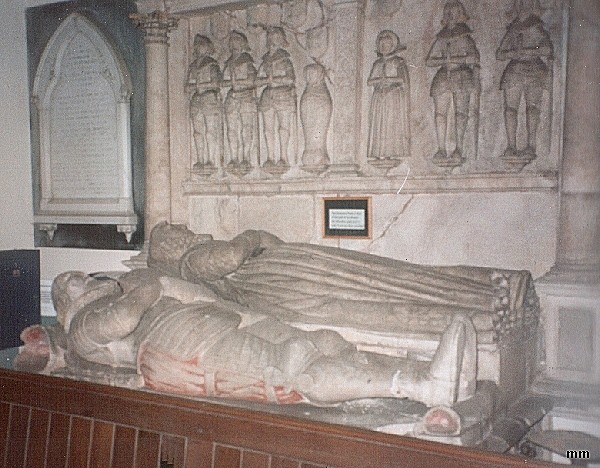 In the vestry behind the organ, the former Bale Chapel, lie the effigies of John and Frances Bale. John is depicted in armour, resting his bare head on a helm, which carries the Bale crest of a lion rampant clutching in his forepaws a broken spear. Wearing long hair and a beard he sports a ruff, a low belt and a breast plate with the pronounced central ridge so typical of the period. Although his hands are now broken off and his legs show signs of repair, his elbows and knees are encased in armour plates. His feet rest on a pair of gauntlets.  Frances, whose head is resting on an embroidered cushion, is also wearing a ruff and has a long waist-length headdress. The hands, now missing, were raised in prayer. Her feet are encased in round-toed shoes. The figures still show traces of red, yellow and gold paint.  Behind the two recumbent effigies, she behind and a little higher, stand identical representations of their six sons and daughter: From left to right the children are: George, who married Elizabeth Hartopp, behind which is Bale (Per pale vert and gules, an eagle displayed argent, armed and beaked or) impaling Sable, a chevron ermine between three otters passant argent (Hartopp). Robert, who married Alice Cowper John An unnamed son, depicted in swaddling clothes, who died in infancy The couple's only daughter (name not known) Francis, who married Margaret Maning behind which is Bale impaling Argent, a chevron between three quartrefoils gules (Maning). Edmund, who married Joyce Roberts, whose uncle William's effigy is at Sutton Cheney, behind which is Bale impaling per pale argent and gules, a lion rampant sable (Roberts). The back panel is bordered by two columns with leaf capitals and is surmounted by an achievement of six coats in a semi-circular surround:
 The achievement, surmounted by the Bale crest, is complete with mantling and the motto Virtus animam coronet ('Vitue crowns the soul').  On the west end of the tomb-chest are two shields containing separately Bale and Brocas (Sable, a lion rampant guardant or). The east end had (it was still there in 1992, but missing on a subsequent visit in 1993) a panel which read:
The front of the chest has two inscription panels separated by a shield charged with Bale impaling Brocas. The inscription reads:
Francisca Uxor ejus dig nissima, e nobili Brocas orum familia oriunda, naturę et gratiæ dotibus adeo illustris ut dubium sit an hac vita in terris longissima, an altera in coalis æterna, dignior habeatur; sed hac laudatissime transacta transit ad alteram 27 die Februarii, anno Dom 1629, ætatis suæ 80. (Lord John Bale, knight baronet, patron of the peace and justice. It is uncertain whether he was more loyal or more fortunate (but from loyalty proceeds good fortune). Celebrated for his hospitable table and his alms (in the praise of ancient Britons). He left here his mortal remains on 10 March in the year of our Lord 1622, at the age of 70, awaiting resurrection to immortality. Frances his most worthy wife, sprung from the noble family of Brocas, so distinguished in the gifts of nature and grace that it is doubtful whether she should be deemed more worthy of this most long life on earth or an eternity in the heavens; but after this life was passed in a most praiseworthy fashion she passed to a higher one on 27 February in the year of our Lord 1630, aged 80.) There is an almost identical creation at Ratcliffe-on-Soar, Nottinghamshire, commemorating Henry Sacheverell, who died in 1625. 
The church of St Mary
Sepulchral Effigies of Leicestershire and Rutland
This website does not gather or store any visitor information.
|