Edith Weston: St Mary |
|
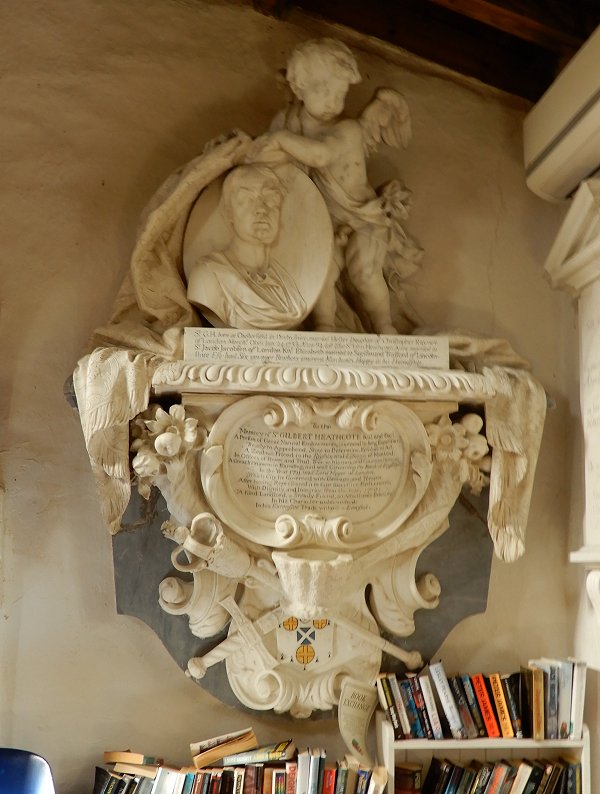
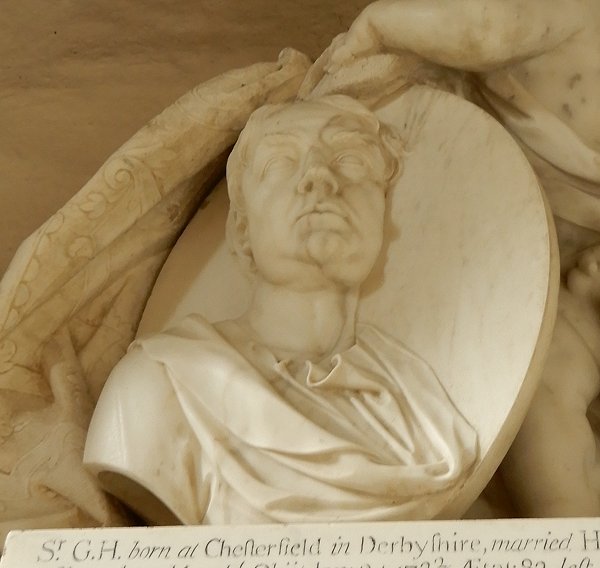 This monument was originally in Normanton church and was moved here in the 1970s when Rutland Water was built. The upper part of the memorial shows a putto holding an oval slab containing Sir Gilbert Heathcote's portrait, beneath which is the inscription:
The lower part of the memorial contains the inscription:
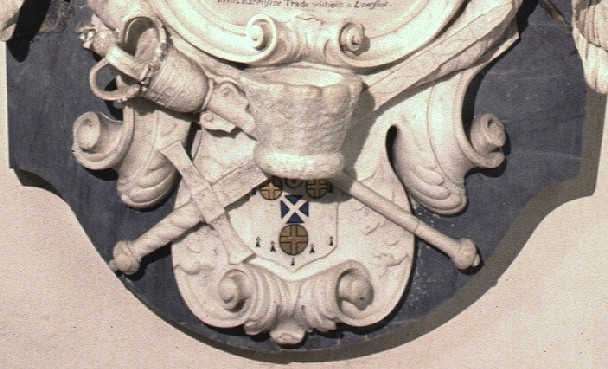 Beneath this inscription are the Heathcote arms Ermine, three pomeis each charged with a cross or, an escutcheon of pretence azure, a saltier argent. Over the arms are the cap of maintenance, sword and mace of the City of London. Gilbert Heathcote was born in 1651 at Chesterfield, Derbyshire. He attended Christ College, Cambridge, where he graduated BA in 1669 and MA four years later. By 1690 he was a prominent wine merchant in the City of London having business dealings with Spain, Jamaica and the East Indies. In 1693, when his ship Redbridge was detained by the East India Company, which claimed a monopoly of the trade with India, he successfully asserted, at the bar of the House of Commons, his right to trade wherever he pleased, unless restricted by parliament. A staunch Whig, in 1690 he was elected a councillor for Walbrook Ward. In 1702 he was made an alderman and knighted. In 1703, after refusing to serve in the office some five years earlier, he was made sheriff. 1710 was a good year for Heathcote for not only was he appointed governor of the Bank of England (which he had helped found in 1694), but he was also elected Lord Mayor of London. He served in three parliaments: in 1714 for Helston; in 1722 for New Lymington and in 1727 for St Germans, Cornwall. In 1732 he was created a baronet and appointed Commissioner for Georgia. Despite his wealth – by 1710 he had amassed £60,000 (equivalent to about £10 million in 2026) – he was well known for his parsimony. In 1712, for instance, he complained of the charge of a few shillings as fees for the burial of his own brother. He was an intolerant man very unpopular with the 'lower orders', some of whom, in May 1715, planned his murder. Even Pope, in Moral Essays felt moved to comment:
That every man in want is knave or fool." Reputed to be the richest commoner in England, on his death in January 1733, he left a fortune estimated to be £700,000 (equivalent to over £150 million in 2026). |
Sepulchral Effigies of Leicestershire and Rutland
Text copyright Max Matthews 2002. Selected text copyright Bob Trubshaw 2025–6.
Images copyright Max Matthews 2002 or Bob Trubshaw 2002, 2025–6.
No copying or reproduction without prior written permission.
Published by Heart of Albion Press
This website does not gather or store any visitor information.