Lutterworth: St Mary |
|
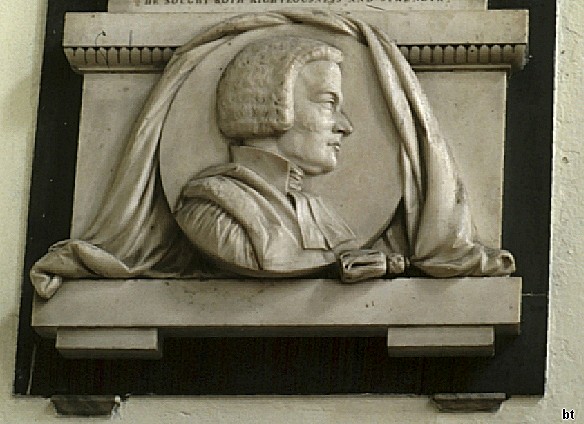 Ryder's bust is on a white marble tablet above which is the inscription:
Henry Ryder was born in 1777 at Strantham, Surrey. After attending Harrow School he went up to St John's College, Cambridge where he got his MA in 1798 and DD in 1813. After being ordained deacon in May 1801, the following August he was presented by the Crown to the Rectory of Lutterworth. In 1802 Ryder, described as a model parish priest, married Sophia, the daughter of Thomas March Philips of Garendon Park, Leicestershire. From 1805 to 1815 Ryder was vicar of the neighbouring parish of Claybrooke. As Canon of St George's Chapel Windsor his sermons were admired by King George III. In 1812 he was appointed Dean of Wells where he introduced Sunday evening services, an idea that was considered 'a sure sign of Methodism'. In 1815, much to the dismay of the conservative churchmen, who disapproved of his evangelical ideas, Ryder was appointed Bishop of Gloucester, during which time he rarely preached less than two sermons each Sunday. In 1816 Ryder established the Gloucester Diocesan Society for the Education of the Poor and the Wells National School. In 1824 he was translated to the See of Lichfield where, according to the diocesan historian Walter Beresford, he 'startled everybody by plunging into evangelical work in all directions'. During his period at Lichfield he opened twenty new churches and saw ten more being built. There is a monument, by Chantry, to Ryder's memory in Lichfield Cathedral.
Sepulchral Effigies of Leicestershire and Rutland
This website does not gather or store any visitor information.
|