Nosely: St Mary |
|
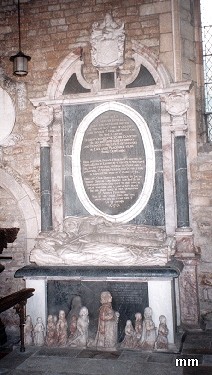 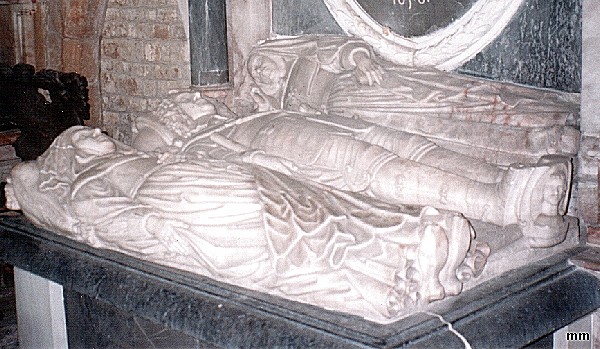 Sir Arthur is depicted in full armour lying between his two wives, Frances and Dorothy. It is most likely that the tomb was originally made with only two figures and completed before Sir Arthur's second marriage the effigy of Dorothy being fitted on as best as the mason could manage. His head reclines upon a cushion placed on his helmet, while his right hand holds a truncheon and his left a sword. The family crest is carved on a small shield affixed to the soles of his feet. 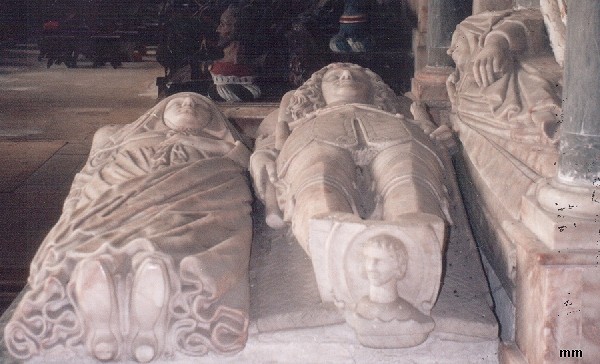 Frances, Arthur's first wife who died in 1632, lies beside her husband. Wearing a long veil, she has her right hand by her side and her left on her breast. Dorothy, the second wife, lies sideways behind the other two effigies. Wearing what looks like a shroud, her head is resting on her right hand, while the left holds a book. Over their heads, between two pilasters and beneath a pedimented coat of arms Argent, a chevron sable between three hazel leaves vert (Hesilrigg) and Or, a whirlpool proper (Gorge), is an oval of black marble containing the inscription:
Here lies Dame Dorothea Hesilrige, sister to Robert Grenville, Lord Brooke, and Baron of Beauchamp-Court. God gave to her true & great wisdome, and a large & just heart. She did much good in her generation. Sir Arthur Hesilrige had by her three sons and five daughters. She left this life ye 28 of January 1650. At the top of one pilaster are the arms of Hesilrige impaling Ermine, two bars sable each charged with five elm leaves or (Elmes). On the other is Hesilrige impaling Sable, on a cross within a bordure engrailed or five pellets (Grevile). 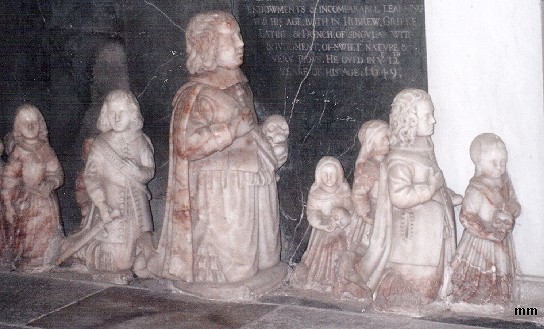
In front of the tomb-chest are the alabaster figures of the children. First the two sons and daughters by the first wife Frances (the daughter of Thomas Elmes of Lilford), followed by the three sons and five daughters by his second wife Dorothy (daughter of Fulke Greville). Against Dorothy's eldest son, who is depicted much larger than the others, is the inscription:
Sir Arthur was a friend of Cromwell and a general in the Parliamentary Army. After his father Thomas died in 1629 Arthur was brought up by John Pym, under whose influence he became a staunch Puritan opposed to the ecclesiastical policy of Archbishop Laud. Elected MP for the County in 1640, his opponent in the second election of that year, Sir Richard Halford, was sent to the Tower for Breach of Privilege when he referred to Sir Arthur as a man with 'more will than wit'. A promoter of the 'Root and Branch Bill' which called for the extirpation of the bishops, Hesilrige was the proposer of the Militia Bill of December 1641. On 3 January 1642, he was one of five MPs who escaped when King Charles entered Parliament demanding the arrest of the five as traitors. The following June he was active in Leicestershire executing the Parliamentary Commission of Array by raising a troop of horse that was incorporated into the army led by Essex. On 5 July 1643, he led his newly formed regiment of London Cavalry 'The Lobsters' into the Battle of Lansdown where he was wounded. The regiment being so named from the complete armour in which they were encased. Such was their effect that an anonymous Royalist was later to write 'had our horse been as good as the enemy's the rebels had never gone off the field unharmed'. In February 1644 he was made a member of the new Committee of Both Kingdoms, a committee of seven peers and fourteen commoners who, together with colleagues from Scotland were to manage the affairs of both nations 'in the common cause'. The next March he and his regiment decided the day for Parliament at the battle of Cheriton. In November 1644, after the King's retreat from Newbury, Hesilrigg showed himself to be on the side of caution against pursuing the Royalist Army. "If they beat the King", he said, "he would still be King… if the King beat them he would overrun the whole country to the gates of London, and there would be nothing to stand against him south of Newcastle." He was appointed Governor of Newcastle in 1647, and violently disagreed with the death sentence passed on Charles and refused to sign the warrant. At the Restoration he was committed to the Tower where he died. The body was removed to Nosely for burial.
Sepulchral Effigies of Leicestershire and Rutland
This website does not gather or store any visitor information.
|