Prestwold: St Andrew |
|
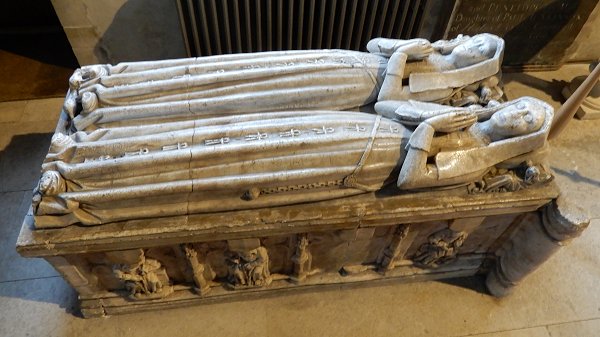
The north lady is represented in a pedimental headdress with a veil falling to the shoulders on each side. She has a double necklace of square links, an open bodice, cordon hanging across to the right side and, in front, ten sets of slashes and bows. Her mantle has close sleeves to the wrists with cuffs. She is wearing rings on the first and third left fingers. The other fingers are broken. The south figure has the same type of dress but a necklace of a different pattern. The bodice is open with eleven frogs from the necklace downwards to her belt. This chain of square links has at the head a rose and at the bottom a boss. She is wearing six rings: two each on the second and fourth right and the first left finger. At her feet is a running dog. Both heads are resting on tasselled cushions that are supported by angels. Collared dogs nibble at the hems of the dresses. 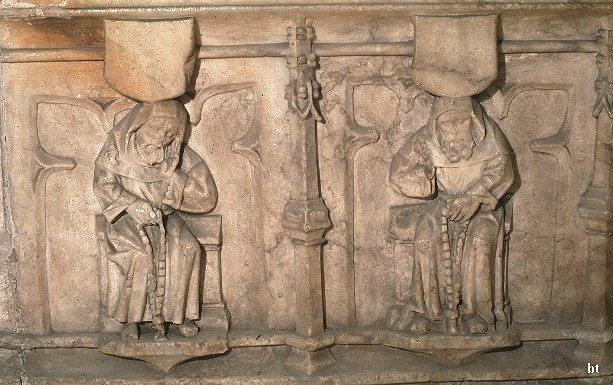 The tomb-chest, which originally carried a canopy (the north-west pillar was there in 1790 but by 1809 had been taken down), had twelve bedesmen, ten of which remain, seated on flat starred quatrefoils, having over each a blank shield. Separated by buttresses these bedesmen are of a style which points strongly to the Burton School and are similar to those found at Castle Donington With no inscription it is not known for certain whom these ladies are, but it is possible that they represent Mary and Elizabeth, the two daughters of Francis Nele, Lord of the Manor, who shared their father's inheritance and built Swarkeston Bridge. Local tradition, however, has it that the effigies represent Gertrude and Grace Lacy, two sisters who lived at Hoton and after whom the 'Two Sisters Well' is named. The legend relates that in the 16th century Prestwold and the surrounding area suffered a three-month drought that caused cattle to die, crops to fail and wells to dry up. One night the two sisters both dreamt of a place in Longdale Field where underground water could be found. The following day, armed with a pilgrim's staff and accompanied by local villagers, they went to the field where they poked the staff into the ground and immediately a column of crystal clear water gust out. In the 19th century a stone structure with steps down and wooden doors was built over the well. This disappeared in World War II and the flow has now been culverted. It is interesting to note that between the figures on the monument there is a hollow that at one time could have held a pilgrim's staff.
Sepulchral Effigies of Leicestershire and Rutland
This website does not gather or store any visitor information.
|